
Galleria dell’Accademia
Audio by: Alessandro
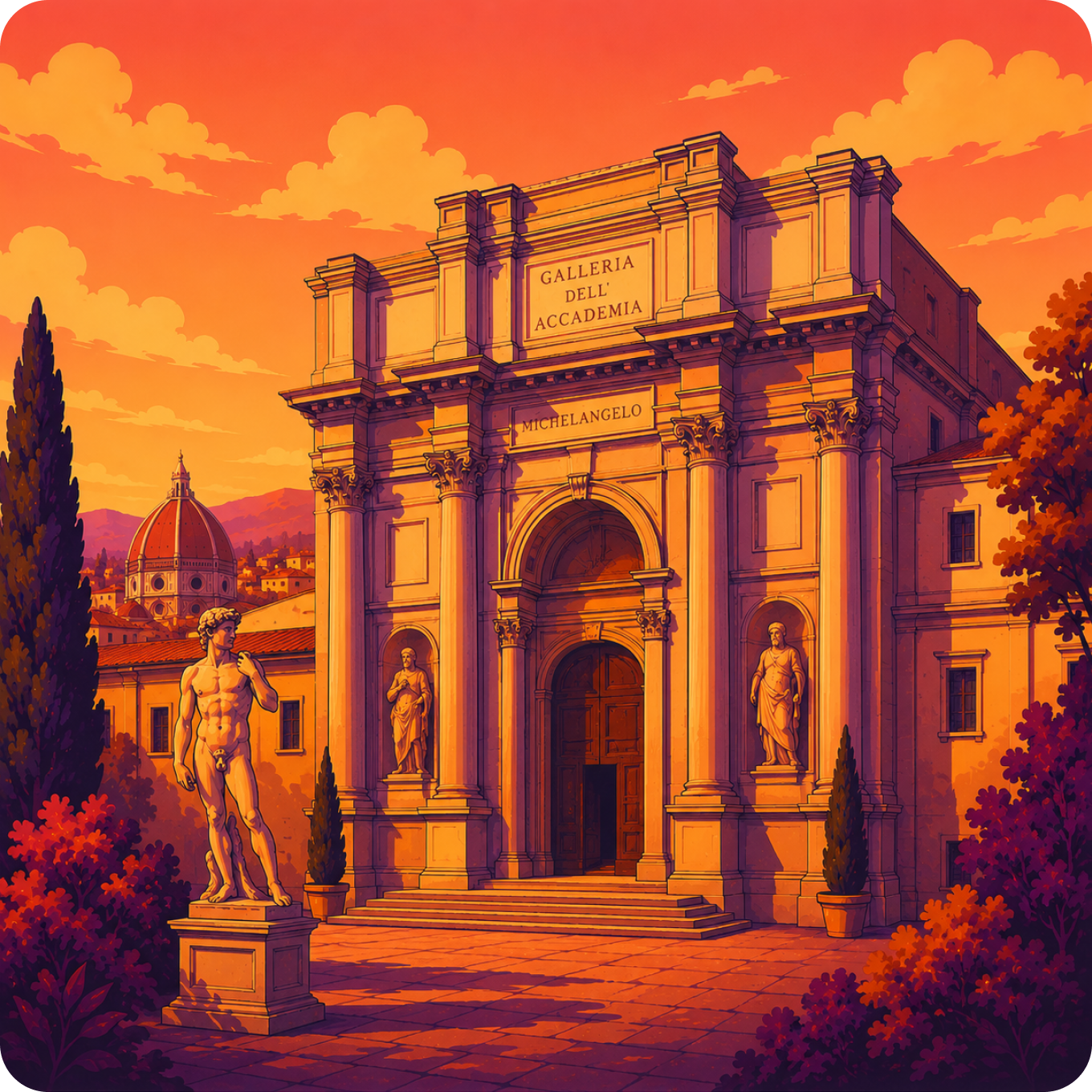
Intro
-
Welcome to the Galleria dell’Accademia.
Before becoming one of the most visited museums in the world, this place had a very different life. The gallery is part of a larger complex of historic buildings that once belonged to religious institutions, including the convent of San Niccolò di Cafaggio and the hospital of San Matteo. In the eighteenth century, under the direction of Grand Duke Pietro Leopoldo of Lorraine, these spaces were transformed to host the Academy of Fine Arts and its growing collection of teaching models and artworks.
I’m Alessandro and I am glad to guide you today in the discovery of the galleria dell’Accademia.
What you see today is the result of that transformation. A place originally designed for care, study, and religious life gradually evolved into a museum dedicated to artistic education and preservation. In the nineteenth century, its role expanded further as masterpieces from across Florence were gathered here, including works removed from churches and public spaces for conservation.
One of the most significant moments in its history came in 1873, when Michelangelo’s David was transferred here from Piazza della Signoria. A dedicated room was built to protect and properly display it, marking a turning point that permanently shaped the identity of the museum.
Today, the Accademia is both a museum and a layered historical space. Its architecture still reflects its origins, while its rooms now guide you through centuries of Florentine art and craftsmanship, from medieval devotion to Renaissance experimentation and perfection.
This journey is not only about individual masterpieces, but about how a living city continuously reshapes its art, its spaces, and its memory.
For now, proceed into the first room, the Sala del Colosso, where the story begins to unfold.
1 - Sala del Colosso
-
As you step into the Sala del Colosso, notice what greets you first. Not a finished masterpiece in marble, but a pale giant in plaster standing at the center of the room. It is Giambologna's Rape of the Sabine Women.
Or rather, it is the model.
The original, carved from a single block of marble, still stands outdoors under the Loggia dei Lanzi in Piazza della Signoria. Here, inside the Accademia, you encounter something more intimate: the sculptor's idea before its final transformation. In a way, it is the perfect beginning for this museum. The Accademia was born as a school, and generations of students learned not from originals, but from casts, models, and copies like this one.
And Giambologna himself saw the work as something more than a story. Born Jean de Boulogne in present-day Belgium, he conceived it first as a challenge of pure virtuosity: three figures intertwined in a spiraling movement, with no privileged point of view. The title Rape of the Sabine Women came only later. The sculpture was meant to be experienced in motion, and unlike the crowded square outside, here you are free to walk around it and watch the composition transform with every step.
Turning away from this whirlwind of bodies, your eye meets a completely different kind of movement. Not the movement of muscles and marble, but the movement of a city.
Look for the long horizontal panel known as the Cassone Adimari. Once thought to be the front of a wedding chest, it is now believed to have been a decorative panel created around 1450 to celebrate the marriage of the Adimari family.
Here, Florence itself becomes the protagonist. Elegant figures in richly colored garments parade through the streets in a festive procession, while in the background you can recognize the Baptistery, the same octagonal building that still stands at the heart of the city today. This is Florence presenting itself in its finest attire, almost as a portrait of the city at its most joyful and refined.
Nearby hangs another work, quieter and more intimate: the Deposition from the Cross. At first glance it may seem like a traditional religious painting, but it carries within it a fascinating story.
It was begun by Filippino Lippi, who died before he could complete it. Several years later, Pietro Perugino was entrusted with finishing the work. If you look closely, you can almost sense the transition between the two painters. The upper part is filled with emotion and movement, while the lower section feels calmer, more balanced, more serene.
One painting, two artists. One beginning, another completion.
Some Florentines of the time criticized the work for lacking unity, but perhaps that is precisely what makes it so interesting. It reminds us that masterpieces are not always born in a single moment or from a single hand.
Keep that thought in mind.
Because as you continue your journey through the Accademia, you will encounter another artist who understood better than anyone that beauty can exist not only in perfection, but also in what remains unfinished.
His name is Michelangelo.
And before long, you will meet him.
2 - Museum of Musical Instrument
-
Pause here for a few minutes, because this room tells you something essential about Florence and about the thread that runs through everything you have seen so far.
Florence did not simply collect beautiful things. It invested in creating them.
The Medici grand dukes, and later the Lorraine rulers, poured money into art, science, music, and theatre. This small museum, opened in 2001 and home to around fifty instruments from the grand-ducal collections, most of them entrusted by the Cherubini Conservatory, is the surviving echo of that ambition. The rooms themselves once belonged to a convent, but the world they preserve is that of the court: a world in which music was not entertainment in the modern sense, but a symbol of prestige, innovation, and power.
After all, Florence was one of the birthplaces of opera. Spectacular performances were organized for Medici weddings and state celebrations, where music, poetry, and stage design came together in a new art form. The instruments around you are among the few survivors of that vanished world.
And one of them changed music forever.
At the end of the seventeenth century, Grand Prince Ferdinando de' Medici invited an ingenious craftsman named Bartolomeo Cristofori to Florence. Cristofori built and maintained the prince's collection of instruments, but he was also an inventor. In a court inventory appears, almost casually, a new word: pianoforte.
Unlike the harpsichord, whose strings are plucked, Cristofori's instrument struck them with small hammers. For the first time, a keyboard player could control volume, moving effortlessly from soft to loud and everything in between. Piano and forte.
The instrument that would one day carry the music of Mozart, Beethoven, and Chopin was born here, in Florence.
Nearby, you can also admire one of the oldest upright pianos in existence, along with elegant spinets and a magnificent ebony harpsichord, all reminders of Cristofori's restless creativity.
Yet the true jewel of this room is not a keyboard, but a viola.
The Medici Viola, crafted by Antonio Stradivari for Grand Prince Ferdinando, belonged to the splendid ensemble maintained by the Medici court. Made of spruce and maple, it is extraordinary for one reason above all: it is the only Stradivari instrument in the world to have survived completely intact, preserved in its original form without alterations or modernization.
Look closely and you will see why it was treasured even in its own time. Delicate inlays of mother-of-pearl, ivory, and ebony decorate its surface, while the Medici coat of arms proudly announces its noble origins. It is both a musical instrument and a work of art.
On the surrounding walls, paintings by Anton Domenico Gabbiani portray Grand Prince Ferdinando alongside the musicians of his court, men whose names we still know today, including the composer Francesco Veracini. Music here was not background. It was glory. It was status. It was culture made visible.
And perhaps that is why this room belongs so naturally within the Accademia.
The same impulse that drove a sculptor to free a figure from marble guided the hands of Stradivari as he shaped wood into a perfect voice. Different materials, different senses, but the same desire: to transform matter into beauty.
Take this room as a moment of calm, a quiet pause in the journey.
Because just beyond it, the stone begins to struggle.
And Michelangelo is waiting.
3 - Gallery of the Prisoners
-
Before you enter the corridor ahead, pause for a moment beside the small bronze bust near the entrance. It portrays Michelangelo, not as the brilliant young apprentice we encountered earlier, but as an old man. The bust was made by Daniele da Volterra, one of his closest friends and followers, who knew him personally and welcomed him into his own home in Rome.
Look at the face. The deep lines, the heavy gaze, the nose visibly flattened after a fight in his youth. Michelangelo carried that broken nose for the rest of his life, just as he carried his work. He sculpted almost until the day he died, at the age of eighty-nine.
We first met him as a boy in Ghirlandaio's workshop. Here, we meet him at the end of his life.
Now walk forward into the work of his prime. Lining the corridor are four monumental figures, twisting and struggling to emerge from rough, unfinished marble. They are known as the Prisoners, or the Slaves, and they were born from what Michelangelo himself came to call "the tragedy of the tomb."
In 1505, Pope Julius II summoned the artist to Rome and commissioned what was intended to be the most magnificent funerary monument in Christendom: a colossal free-standing tomb with more than forty statues rising on several levels inside Saint Peter's Basilica.
Michelangelo threw himself into the project. He personally travelled to the quarries of Carrara to select the marble, marking the blocks he wanted with three carved circles. But almost immediately the dream began to unravel. Funds were diverted, priorities changed, and the commission was repeatedly reduced. After Julius's death, the design was scaled down again and again. What was supposed to be a masterpiece became a burden that haunted Michelangelo for nearly forty years.
In the end, only a fraction of the original vision was realized, culminating in the tomb you can still see today in Rome, crowned by the magnificent Moses.
These four figures, however, never reached their destination. They remained in Michelangelo's workshop until his death. Later, they entered the Medici collections and spent centuries in the artificial grotto of the Boboli Gardens, where their rough surfaces blended almost naturally with the rock around them. Only in 1909 were they transferred here to the Accademia. Two more unfinished companions eventually found their way to the Louvre in Paris.
But perhaps their unfinished state is precisely what makes them so extraordinary.
Michelangelo believed that every block of marble already contained the figure hidden within. The sculptor's task was not to create, but to liberate. Sculpture, for him, was an act of revelation.
And here, you are witnessing that process itself. One figure strains to free a shoulder. Another twists his torso as if awakening from sleep. A bent leg pushes outward. A face begins to surface from stone that is still partly mountain.
Walking slowly down the corridor feels almost like watching a single body struggle through different moments of the same transformation. Some have seen in these figures the image of the human soul itself, imprisoned within matter and striving toward freedom.
Their roughness, their incompleteness, is what makes them so moving. They are not monuments to perfection, but to becoming. And perhaps that is why this corridor was designed the way it is.
Because if you lift your eyes beyond the struggling giants, you will see, at the far end of the gallery, illuminated beneath its dome, a solitary figure already waiting for you.
Unlike these prisoners, that figure has fully emerged from the stone. You can already see him. But do not hurry. Stay with these unfinished bodies a little longer. Feel the tension, the waiting, the struggle.
Because only after witnessing the effort of liberation are you truly ready to meet the one figure who has finally been set free.
David awaits.
4 - The David of Michelangelo
-
And now, at the end of the corridor, you stand before him.
Giorgio Vasari, who saw the statue not long after its completion, wrote that this single work had surpassed every sculpture, ancient or modern. But before you raise your eyes to David, think for a moment about the block from which he emerged.
The marble belonged to the Opera del Duomo, the institution responsible for Florence's cathedral. It had been quarried decades earlier for a colossal figure intended to stand high above the city, on one of the cathedral's buttresses. But the block itself posed a problem. Too narrow, too shallow, and marked by imperfections, it defeated two sculptors in succession. One tried in 1464, another in 1475. Both abandoned it.
For decades, the enormous slab lay forgotten in the workshop yard, exposed to the elements. It became an embarrassment, an expensive piece of marble that no one knew how to use.
Then, in 1501, it was offered to a young sculptor of twenty-six years old. Michelangelo had recently astonished Rome with his Pietà, and he accepted the challenge. For nearly three years, he worked almost entirely alone, shielding his progress behind wooden screens. Few knew what was emerging from the ruined stone.
And what emerged was not the David anyone expected.
Artists before him, including Donatello and Verrocchio, had shown the biblical hero after his victory over Goliath. Michelangelo chose a different moment. This is not the triumph. It is the instant before.
The sling rests over his shoulder. A stone is held lightly in his right hand. The brow is furrowed. The neck muscles tighten. The veins swell. His weight settles naturally onto one leg, while the other relaxes, creating that subtle balance known as contrapposto. Everything is still, and yet everything is about to happen.
David has not won. He is deciding.
According to the Bible, he rejected the heavy armor offered to him and went into battle armed only with a sling and his faith. Michelangelo strips him of every symbol of power. There is no sword, no trophy, no giant lying defeated at his feet. Only intelligence, courage, and resolve.
If the crowd allows, step closer. Look at the veins running across the lowered right hand, the tension of the abdomen, the concentration in the face. The eyes, deeply carved beneath the brow, seem fixed on something beyond you. Michelangelo gave them this intensity deliberately. In the Book of Samuel, David is described as beautiful and bright-eyed, and the sculptor transformed that description into stone.
This is a face that is thinking.
The proportions, too, reward careful observation. The head and hands appear unusually large. One explanation is practical. The statue had originally been intended to stand high above the ground, and exaggerated proportions would have corrected the perspective. Another interpretation is symbolic: the head represents reason, the hand action. Intelligence guiding strength.
When the statue was unveiled in 1504, the reaction was immediate. A committee of Florence's greatest artists, including Leonardo da Vinci, gathered to decide where it should be placed. They abandoned the original plan for the cathedral and chose a far more prominent location: in front of the Palazzo della Signoria, the seat of government.
There, David became more than a biblical hero.
For Florence, a small republic surrounded by powerful rivals, he became a political symbol. Like David facing Goliath, the city saw itself as small but determined, relying on intelligence and courage rather than brute force.
We even have the testimony of a witness. A Florentine apothecary named Luca Landucci recorded how, in May of 1504, workers had to demolish part of the workshop entrance to extract what people already called "the Giant." More than forty men moved it through the streets over four days, using wooden rollers and an elaborate system of ropes. During the journey, stones were thrown at the statue during the night, perhaps by political opponents.
For nearly three hundred and seventy years, David stood outdoors. In 1527, during political unrest, a bench thrown from a palace window shattered the left arm into several pieces. The fragments were carefully preserved and later restored. Even here in the museum, the statue suffered another attack in 1991, when a man damaged one of the toes with a hammer. Once again, it was repaired.
Finally, in 1873, David was brought inside to protect him from weather and pollution. This tribune, crowned by its dome and illuminated from above, was built specifically for him. For a time, while the room was being completed, the statue remained hidden inside a wooden crate. The copy that now stands in Piazza della Signoria was installed later.
And perhaps that brings us back to the Prisoners you have just passed. Those unfinished giants struggle to emerge from stone. David has already emerged.
The block that others abandoned, the marble everyone considered unusable, became one of the most recognizable human figures ever created.
Not because Michelangelo imposed a form upon the stone. But because, as he himself believed, the figure had always been there. He simply set it free.
5 - Gipsoteca Bartolini
-
After everything you have just seen, this long, bright hall changes the rhythm completely. It feels cooler, quieter, almost analytical. And if you listen closely, it also offers a kind of counterpoint to the rooms that came before.
Start with the space itself. This was once the women’s ward of the old hospital that Grand Duke Pietro Leopoldo transformed in 1784, when he founded the Academy here. Today it is filled, wall to wall, with white plaster: the working world of a nineteenth-century sculptor, Lorenzo Bartolini, professor at the Academy, together with his colleague Luigi Pampaloni.
More than two hundred and fifty works are gathered here. Busts, full figures, funerary monuments. Walking through them feels like entering a studio suspended in time. You can read the taste of an entire century in these forms: the soft drapery inspired by antiquity, the high-waisted Empire silhouettes, the carefully studied expressions that aim less at ideal beauty than at psychological truth.
Bartolini in particular became the portraitist of choice for Europe’s elite. Russian, English, and Polish families who settled in Florence commissioned him repeatedly, drawn to his ability to capture not just likeness but character. Alongside them appear Tuscan historical figures too, including Machiavelli, presented here almost as a model of civic intelligence as much as of individual identity.
But as you move closer, another layer of this room begins to reveal itself.
Look at the surface of the plaster. You will notice small dark points scattered across it. These are not imperfections. They are pointing marks: tiny metal reference pins used in the process of translation from model to marble.
The method was precise and almost mechanical. First, the sculptor shaped a clay model. Then it was cast in plaster. Finally, it was marked with these measured points, allowing assistants to transfer the form into stone with exact control over depth and proportion. Each mark told the marble cutter how far to go before reaching an eye, a fold, or a contour.
It is a system built on repetition, accuracy, and correction. A system in which mistakes remain possible, because plaster can be remade and discarded before anything reaches the irreversible stage of marble.
And here, almost without needing to say it, a comparison emerges with the room you have just left.
Michelangelo carved directly into a single block. No full-scale model. No safety layer. No possibility of correction. He worked in a state of absolute commitment, trusting that the figure already existed within the stone and only needed to be released.
Two rooms, side by side, and two opposing philosophies of creation. One is incremental, transferable, and controlled. The other is immediate, irreversible, and an act of faith.
Before you move on, look for two plaster portraits among the collection: Brunelleschi and Arnolfo di Cambio, the architects who began the cathedral and later crowned it with its dome. Their presence here feels appropriate, as if the history of Florence’s greatest construction returns, reduced to study and measurement.
On the left wall, you will also find a small fresco in soft green tones. It depicts scenes of life inside the hospital as it once was: women in prayer, acts of charity, nuns tending to the sick in wooden beds. For a long time it was attributed to Andrea del Sarto, but is now recognized as an early work by Pontormo.
What makes it particularly striking is not only its style, but its memory. It was painted when this room was still a functioning ward, before it became a museum, while life here was still defined by care, illness, and recovery. In a sense, the building is remembering itself.
And so this room becomes something more than a collection of plaster models. It becomes a reflection on how things are made, how they are corrected, and how they endure.
After the struggle of marble and the certainty of stone, here everything is provisional again. And that, too, is part of the story.
6 - The tree of Life
-
For your final stop, you travel back in time almost two centuries before Michelangelo was born to around 1305.
This is the oldest core of the entire museum: a sequence of rooms devoted to Florence’s earliest painting. Tempera and gold on wood, brought here from churches and convents across Tuscany, they belong to a world where painting was still inseparable from devotion.
Around you are the followers of Giotto, the painter who, just a generation earlier, began to give sacred figures weight, presence, and human feeling. You see Bernardo Daddi with his monumental crucifix, and Taddeo Gaddi, who spent decades in Giotto’s workshop, represented here in delicate narrative scenes from the lives of Christ and Saint Francis.
In the adjoining spaces, the Orcagna brothers: Andrea, Nardo, and Jacopo di Cione, fill their altarpieces with scenes of Pentecost and the Trinity, set against vast fields of burnished gold. That gold is not decoration in the modern sense. It is language: a way of lifting sacred figures out of time, suspending them in an eternal, unchanging light.
But among all these works, there is one that gathers everything into a single image.
Find the great panel known as the Tree of Life, painted by Pacino di Bonaguida, a Florentine master who was also one of the finest manuscript illuminators of his time. That dual skill is visible immediately: every surface is dense with detail, like a page meant to be read slowly, almost word by word.
At first glance, it appears to be a crucifix. Look again, and the cross becomes a living tree.
Twelve branches rise from its trunk. From each branch hang circular medallions, and within each medallion unfolds a scene from the life of Christ. The structure comes from the Book of Revelation, which describes the Tree of Life bearing twelve kinds of fruit, one for each month, its leaves bringing healing to the world.
Follow the image downward. The roots sink into the rocky ground of Calvary, the site of the crucifixion. On either side, the story begins again at its origin: the Creation of the world, and Adam and Eve expelled from Eden. Everything is contained here: beginning, fall, incarnation, and redemption, compressed into a single vertical structure.
And at the very top, the narrative resolves into vision. The Virgin sits enthroned with the Christ Child, surrounded by angels and saints, as if the entire tree were growing toward this final moment of completion.
Look closely and you may notice a small, almost hidden detail near the summit: a pelican, piercing its own breast to feed its young with its blood. An ancient symbol of sacrifice, it echoes the logic of the entire panel, life sustained through self-giving.
This work was created for a community of cloistered Poor Clares, meant to be contemplated in silence, perhaps for hours at a time. It is not an image to be consumed quickly, but one to be entered slowly, like a meditation. And it is the perfect place to end. Because it quietly completes a circle.
You began your visit watching Michelangelo wrestle a living form out of abandoned stone. Here, you end with a wooden panel where life itself grows out of death, where a tree emerges from a cross, and where narrative becomes nature.
The same gesture, separated by six hundred years and two materials: stone becoming flesh, wood becoming vision.
This is what the Accademia ultimately holds together. Not a collection of objects, but a long meditation on a single idea, the moment when matter becomes alive in human hands.
If this is your first encounter with Florence, the city continues beyond these walls. Across the river, the Uffizi traces the unfolding history of painting. Beyond that, other cities, other stories, other guides await.
But for now, step back into the light. You came here to see a famous statue. What you have really witnessed, room by room, is something else entirely. Matter learning how to breathe.