
Duomo Experience
Audio by: Alessandro
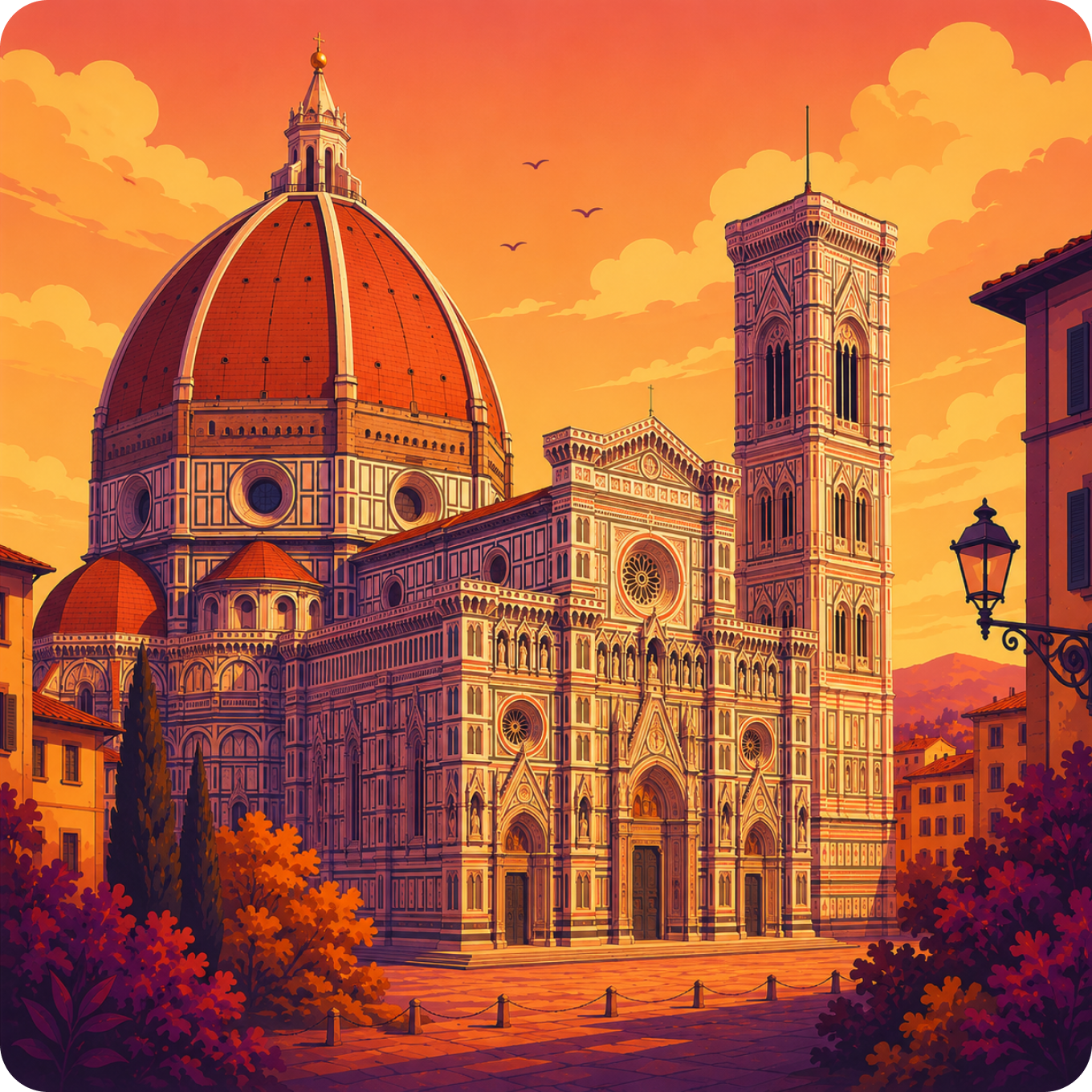
Intro
-
Hello, my name is Alessandro, and I am excited to guide you through one of the most extraordinary places in the world.
When most people think of Florence, they think of art. They think of Michelangelo, Leonardo, Botticelli.
But before all of that, there was this.
The Duomo.
Not simply a church, but a symbol. A symbol of faith, certainly, but also of ambition, pride, ingenuity, and competition.
Because this complex was never just about religion.
It was about a city.
A city that wanted to prove something to itself and to the world.
During the Middle Ages and the Renaissance, Florence was one of the richest and most influential cities in Europe. But it was also constantly competing with cities like Venice, Milan, and Siena. And like every great power, Florence wanted a monument that would embody its greatness.
The result was Santa Maria del Fiore.
A cathedral so ambitious that for decades nobody knew how to complete it.
And perhaps that is what makes this place so fascinating.
Because the story of the Duomo is ultimately a human story.
A story of vision. Of impossible challenges. Of artists and engineers. Of rivalry and perseverance.
And above all, of one man who dared to solve a problem that everyone else thought was unsolvable.
His name was Filippo Brunelleschi.
Throughout this journey, we will discover not only a cathedral, but the ideas that gave birth to it. Faith. Power. Civic pride. And human ingenuity.
Because the Duomo is much more than a building.
It is a monument to what people can achieve when imagination and determination come together.
So, let us begin our journey.
1 - Piazza del Duomo
-
Before stepping inside any building, it is worth taking a moment to understand what stands before you.
Because this square is much more than a collection of monuments.
For more than seven centuries, this has been the spiritual and symbolic heart of Florence. A place where faith, politics, ambition, and civic pride came together to create something extraordinary.
In front of you stand four great monuments: the Cathedral of Santa Maria del Fiore, Giotto's Bell Tower, the Baptistery of San Giovanni, below you the Church of Santa Reparata and, hidden from view, the treasures preserved in the Opera del Duomo Museum. Together, they form a single complex, one that tells the story not only of a church, but of an entire city.
During the Middle Ages, Florence was becoming one of the wealthiest and most influential cities in Europe. Its merchants traded across the Mediterranean, its bankers financed kings and popes, and its artists and thinkers were beginning to shape what would later become the Renaissance.
But Florence was not alone. Cities such as Venice, Milan, Pisa, and Siena were all competing for power, prestige, and influence. And like every great city, Florence wanted a monument worthy of its ambitions.
The result was a project unlike anything the city had ever attempted.
In 1296, work began on a new cathedral dedicated to Santa Maria del Fiore, Saint Mary of the Flower. The flower, represented by the lily, had long been the symbol of Florence itself. This was not just a church for the clergy or the nobility. It was intended to be the people's cathedral, a monument that embodied the identity and aspirations of the entire city.
Generation after generation contributed to its construction.
Architects, sculptors, painters, engineers, craftsmen, and ordinary citizens all played their part. Some devoted their entire lives to a project they knew they would never see completed.
And perhaps that is one of the most remarkable things about this place.
The Duomo complex was not created in a few years. It was the work of centuries.
Each generation added something new.
The Baptistery recalls the ancient roots of Florence. The cathedral expresses the confidence and wealth of the medieval republic. The dome, still dominating the skyline today, represents one of humanity's greatest triumphs of ingenuity and imagination.
But above all, this square tells a story about a city that believed greatness could be built.
Not overnight. Not by one individual.
But through the shared effort of countless people united by a common vision.
And although Florence has changed enormously over the centuries, this square remains its beating heart.
Everything begins here. And so does our journey.
2 - The Baptistery
-
Before the cathedral, before the dome, before the tower that defines the skyline, there is this building.
The Baptistery of San Giovanni. And in many ways, this is where Florence begins.
Florence Cathedral does not stand alone. It is paired with a baptistery placed directly in front of it, separated by design. This separation reflects an ancient belief: no one could enter the main church before being baptized. So this space became the true threshold of the city, the place where life in Florence officially started.
Construction of the Baptistery began around 1059 and was completed in the 12th century, making it older than the Duomo itself and already ancient by the time the cathedral was even imagined. Its geometry is strict and powerful: an octagon wrapped in white and green marble, a visual language that would later define Florentine architecture, echoed in places like San Miniato al Monte above Piazzale Michelangelo. Parts of its structure even incorporate materials believed to come from Roman Florentia, which helped fuel the medieval myth that this was originally a temple of Mars. It was not, but the belief is revealing: Florence consistently saw itself as the heir to Rome, and this building was already part of that identity.
For centuries, this was the spiritual front door of the city. Every Florentine was baptized here, without exception. Among them was Dante Alighieri, who would later carry the memory of this place into his Divine Comedy, calling it his beautiful San Giovanni.
Step closer to the doors. Because this is where the story turns.
What you are looking at are the Gates of Paradise, Lorenzo Ghiberti’s masterpiece. The doors you see today are replicas, created to preserve the originals, which are now housed in the Opera del Duomo Museum and will be seen later in this journey. Michelangelo is said to have looked at them and declared them worthy of paradise, and the name stayed.
But these doors are not the beginning.
The beginning is a competition held in 1401, when the city decided to commission a new set of bronze doors. Among the contestants were two young artists: Lorenzo Ghiberti and Filippo Brunelleschi. Each submitted a trial panel. The judges chose Ghiberti. Brunelleschi lost.
And what he did with that loss changed everything.
Instead of continuing in Florence, he went to Rome. There, among the ruins of the ancient world, he studied what remained of imperial architecture. He measured, observed, and learned how the Romans had built vast domes and vaults without the limitations of medieval construction. What he discovered there would later become the key to solving Florence’s greatest architectural problem: the impossible dome of the cathedral.
So the man who lost the doors became the man who would later win the sky.
Now look up. The ceiling above you is covered in gold mosaics, dense and luminous. At its center is a monumental image of Christ in Judgment, surrounded by scenes of salvation and damnation. Across the vault unfold stories of John the Baptist, Christ, Joseph, and the creation of the world. The Last Judgment dominates three of the eight segments, an overwhelming vision of cosmic order and moral consequence.
It is possible that Dante once stood here, looked up at this same vision of Hell, and carried its imagery into the Inferno.
And now, as you turn away from the Baptistery and toward the cathedral, the mood shifts completely.
Because everything you have seen so far was only the beginning.
3 - Santa Maria del Fiore Cathedral
-
Before stepping inside, take a moment to admire the façade.
White marble from Carrara, green from Prato, and delicate pink tones from the Maremma combine to create one of the most recognizable images in the world.
It feels timeless. It feels medieval.
But appearances can be deceiving. The façade you see today, at which you are taking pictures, is actually much younger than photography itself. It was only completed in 1887.
For nearly three centuries before that, this magnificent cathedral stood with a plain, unfinished brick front. Florence had built the body of the church and crowned it with the greatest dome in the world long before deciding what face it would show to the city.
And perhaps that tells us something important about this place. The Duomo was never the work of one man or one generation. It was the product of centuries, built by people who often began projects they knew they would never live to see completed.
And unlike many great monuments, this one was not commissioned by a king. Florence had no king.
This was a republic of merchants and bankers. The construction was financed largely by the powerful wool guild, the Arte della Lana, whose members invested their wealth into creating something worthy of the city.
Their ambition was enormous. When work began in 1296 under Arnolfo di Cambio, the intention was clear: to build a cathedral so magnificent that no human effort could surpass it. And remarkably, they almost succeeded.
Santa Maria del Fiore, the Virgin Saint of Flowers, was finally consecrated in 1436, after more than two centuries of construction.
Now, step inside the Duomo and notice your first reaction. For many visitors, it is surprise.
After the colorful marble outside and the glittering mosaics of the Baptistery, the interior appears almost austere. Vast, solemn, and surprisingly simple.
But this simplicity is intentional. This church was built not to overwhelm with decoration, but with scale.
When completed, it was among the largest churches in all Christendom, capable of holding tens of thousands of Florentines. Imagine the entire city gathered here for a feast day, a sermon, or during times of plague and uncertainty.
The emptiness you perceive today is really just the absence of that crowd. Its architecture reflects the long history of its construction.
The earliest sections belong to a more Romanesque tradition, with thick walls and relatively small windows. Later generations incorporated Gothic ideas and, eventually, Renaissance innovations. Rather than belonging to one style, the cathedral is the result of over two hundred years of architectural evolution.
And there is another reason why the interior seems relatively bare. Many of the masterpieces that once filled this space were moved across the square to the Opera del Duomo Museum, where they could be preserved and protected. We will discover them later.
But the walls are not entirely silent. Near the entrance, look up at the extraordinary clock painted by Paolo Uccello in 1443.
At first glance, it seems ordinary. But look closely. The numbers run in the opposite direction from what we are used to. The clock follows the ancient Ora Italica, according to which the day ended at sunset rather than midnight.
It still works today, a small reminder that people of the fifteenth century experienced time itself differently.
Nearby, you may notice the portrait of a man dressed in red, holding a book, with Florence and the mountain of Purgatory behind him. This is Dante Alighieri.
Born and baptized in Florence, he would later be exiled from the city he loved most. In life, Florence rejected him. In death, it immortalized him here, inside its cathedral.
And high upon the walls, two monumental equestrian portraits commemorate mercenary commanders who fought for the Republic. Curiously, these are not sculptures at all, but frescoes painted to imitate expensive monuments. Even in glory, the Florentines remained practical.
Now, walk toward the center of the cathedral, and look up. Above your head unfolds one of the largest fresco cycles in the world. The Last Judgment.
Begun by Giorgio Vasari and completed by Federico Zuccari, it fills the inside of the dome with angels and demons, saints and sinners, heaven and hell.
For centuries, these images were much more than decoration. They were reminders of eternity.
But perhaps the greatest masterpiece above you is not the fresco itself. It is the dome. Because for decades, this enormous opening remained empty.
The people of Florence had designed a church with a hole at its heart. A space so vast that no architect, engineer, or builder knew how to close it. Many believed it simply could not be done. But one man believed otherwise. His name was Filippo Brunelleschi.
And his story is the story of how the impossible became possible.
4 - Santa Reparata
-
Before you go up… go down.
Most visitors never notice this. They head straight toward the dome, drawn upward by the scale of the cathedral. But just here, in the nave, there is a small staircase sinking into the floor.
Take it. Because you are about to leave the cathedral you see — and step into the one it was built on top of.
Down here, beneath your feet the entire time, are the remains of another church. Older. Smaller. Forgotten, but never truly gone. Its name was Santa Reparata.
For the better part of a thousand years, this was the cathedral of Florence. Named after a young Christian martyr from the early centuries of the Church, a symbol of protection and victory for the city. She was once deeply loved by the Florentines. She was theirs.
And yet, as Florence changed, so did its ambitions. Look around you. You are not looking at a single building. You are looking at layers.
Roman pavement at the bottom. Early Christian foundations above it. Then medieval structures, tombs, repairs, and modifications. Century after century, each generation building over the last.
This is not just archaeology. This is Florence writing over itself.
And that story became especially visible during a major archaeological excavation carried out between 1965 and 1973, when the entire area beneath the cathedral was systematically explored for the first time.
What they uncovered was extraordinary. Mosaics that date back to the time of Florentia, the Roman city that existed here long before medieval Florence. In some cases, these fragments go back over two thousand years.
Beneath the cathedral, the city of Rome is still present.
Alongside the mosaics, archaeologists found everyday objects: fragments of tools, a Lombard belt buckle, and countless small relics that once belonged to people who lived, prayed, and were buried here.
They also discovered tombs. Some of them still contained artifacts and personal objects, offering rare glimpses into lives that would otherwise have been completely lost.
The more they dug, the more they found. And at a certain point, they made another unexpected discovery. The tomb of Filippo Brunelleschi.
At the time of excavation, its exact location had been forgotten. It was only during this work beneath the cathedral that it was rediscovered — a quiet resting place for the man who had changed the skyline of Florence forever.
And he is not alone in this ground. Other important figures connected to the construction of the Duomo complex were also buried here, even if not all of their tombs have been found.
It is a striking thought. The architects who shaped this square did not end up in grand monuments above ground, but beneath it — inside the very structure they helped create.
And the story does not stop there. Because Santa Reparata itself was not immediately erased when the new cathedral rose.
For decades, the old church continued to function inside and beneath the growing structure above it. The people of Florence worshipped in the old space while, just overhead, the new cathedral slowly took shape. It was only when the Duomo became self-supporting that the ancient basilica was finally dismantled, and what remained was buried beneath the new floor.
Even now, you can still trace fragments of that earlier world. Look closely at the mosaics under your feet. Among them, you may notice a large peacock — a symbol of immortality — preserved in stone, still watching over the space after more than a millennium.
These are not just decorations. They are echoes. And they remind us that this place was never static. It was continuously built, destroyed, rebuilt, and transformed.
Florence did not replace its past. It layered it. And now, standing here beneath the cathedral, you are not in a basement. You are in the foundation of history itself.
When you are ready, return to the surface. Because what awaits above is something no one in Florence knew how to complete for more than a century. A space so vast, so ambitious, that it remained open to the sky… until one man decided it could not remain impossible.
5 - Brunelleschi and the impossible dome
-
When you stand beneath the dome of Santa Maria del Fiore, you are not just inside a church. You are inside a problem that no one knew how to solve.
For more than a century, the cathedral had stood like this: complete in its body, but open at its crown. A vast empty space, waiting for a solution no one could yet imagine.
The challenge was simple to describe, but almost impossible to execute. How do you build a dome over a span of more than 45 meters, rising to a height of over 116 meters, without any supporting structure underneath?
In earlier centuries, domes were built using enormous wooden frameworks. Temporary scaffolding that held everything in place until the stone could stand on its own. But here, that was no longer possible.
The scale was too large. The weight too extreme. The cost unthinkable. There was not enough timber in Tuscany to build the scaffolding required.
And so Florence was left with something extraordinary. A cathedral that could not be finished. A monument suspended between ambition and impossibility.
In 1418, the city decided to confront the problem directly. A public competition was announced to design the solution. Among the participants were some of the most respected craftsmen of the time, including Lorenzo Ghiberti. But the man who would ultimately change everything was not the obvious choice.
Filippo Brunelleschi was, at that time, a goldsmith and sculptor. A man of precision, not of monumental architecture. And yet he saw something others did not. He refused to reveal his full method. He feared it would be stolen. Instead, he offered a demonstration.
An egg, placed on a table. He challenged the other architects to make it stand upright, they tried, they failed. Then he gently cracked its base, flattened it slightly, and stood it upright. Anyone can do it now that you have seen it, he said.
And that was the point. The solution always appears simple once revealed. The challenge is seeing it first.
Brunelleschi’s answer was radical. He would not build a dome that relied on scaffolding. He would build a dome that supported itself as it rose. A structure that carried its own weight from the very beginning.
He designed a double shell: an inner dome that carried the structure, and an outer dome that protected it and defined its shape. Between them, a hidden system of ribs and reinforcements distributed the load.
And to bring it to life, he invented entirely new machines. Hoists, cranes, and lifting devices designed specifically to move heavy materials vertically and horizontally at unprecedented heights.
But the true secret lies in the brickwork. Bricks arranged in a herringbone pattern, locking each ring of construction into the next. Each completed circle becoming the base for the one above it. No full wooden skeleton, no external support, just geometry and control. A structure that builds itself upward, like a stone that learns to rise.
And perhaps most remarkably of all, Brunelleschi left no complete plans behind. Even today, some aspects of his method remain debated.
What is certain is this: between 1420 and 1436, Florence watched something impossible take shape above its skyline.
Brick by brick, the empty sky began to close. And by the time it was finished, the world had changed what it thought architecture could be. Santa Maria del Fiore was finally complete. And Brunelleschi had proven something that would define the Renaissance. That limits are not fixed. They are only waiting to be redefined.
6 - Inside the dome - the last judgment
-
Now look up. Not just at the dome as a structure, but at what it became. Because Brunelleschi created the space, but the meaning inside it came later, from a different world entirely.
After the dome was completed in 1436, Florence eventually decided to transform its interior into something even more ambitious: a vast painted vision of the afterlife covering the largest masonry vault in the world.
What you see above you is the Last Judgment. A monumental fresco cycle begun by Giorgio Vasari and completed by Federico Zuccari in the late 16th century.
Heaven rises above in ordered clarity. Angels, saints, and the redeemed are arranged in structured harmony, drawn upward toward light and salvation. Below them, chaos unfolds. Demons, collapsing bodies, and the damned spiral downward into darkness and punishment.
Everything is organized vertically. Salvation above, judgment in the middle, condemnation below. This is not decoration. It is a worldview made visible. A Renaissance attempt to map morality, destiny, and the structure of existence onto architectural space itself. And in doing so, the dome becomes something more than engineering. It becomes a diagram of humanity.
From here, the structure itself reveals its second nature. Because the dome is not only something to observe. It is something to enter.
As you move higher, the distance between you and the painted surface disappears. What once seemed distant and abstract becomes immediate, surrounding you in detail and scale.
At certain points, the perspective inverts. The painting is no longer above you, it is around you. Higher up, the cathedral floor shrinks into geometry far below, while the fresco opens fully around your position.
At the lowest registers of the Last Judgment, the imagery becomes intense and physical: demons, tortured figures, scenes of collapse rendered with theatrical force.
It echoes the visual language you encountered earlier in the Baptistery, completing a cycle that begins and ends with judgment. One vision opens the experience. The other completes it.
But the most important revelation is not the painting. It is the structure that holds it. Because at this height, you are no longer simply looking at the dome. You are inside Brunelleschi’s solution.
A double-shell system: an inner dome carrying the structural load, and an outer dome defining the silhouette of Florence. Between them, a hidden architectural space where the entire logic of the construction becomes visible. Bricks laid in a herringbone pattern lock each ring of masonry into the next, allowing the dome to support itself as it rises.
No scaffolding. No full wooden framework. Only geometry, gravity, and invention. A structure that built itself upward.
And as you finally reach the upper level, Florence opens beneath you. A city shaped by centuries of trade, rivalry, and ambition, now resting quietly under the dome that defines its skyline. From here, the cathedral is no longer just part of Florence. It is Florence’s center. A permanent reference point in stone.
And there is one final detail that closes this story. In 1601, a violent lightning strike hit the top of the dome so powerfully that the copper sphere and cross were torn from their position and crashed to the ground behind the cathedral. The impact was so strong that the city marked the exact spot where it landed with a circular marble plaque, which can still be seen today. The sphere was repaired and reinstalled the following year, returning to its place at the summit. And it has remained there ever since. A reminder that even the most perfect human constructions are not beyond nature.
And yet, despite everything, the dome still stands. Not just as architecture. But as proof that something once thought impossible was, in fact, built.
7 - Giotto’s Bell Tower
-
After the dome, this climb feels almost gentle, and that is exactly what makes it so revealing, because the dome had one strange limitation as an experience: while you were inside it, you could not see it. You were inside the solution, not its final form. This tower is different, this is where you finally see the answer.
But before you climb, give it its due, because even its name carries a familiar Florentine twist. We call it Giotto’s Campanile, after Giotto the painter who more than anyone transformed Western art from flat gold backgrounds into real space, real bodies, and real emotion. The city appointed him master of the cathedral works, and he designed this tower, laying its foundations and beginning its rise. But he died before it truly took shape, leaving only the lowest level completed. Everything above was built over decades by other hands, including Andrea Pisano and Francesco Talenti, who had to adjust and strengthen Giotto’s original design because parts of it were too slender to safely reach the height Florence wanted. So like the façade of the cathedral, like the lantern of the dome, this tower carries a famous name but belongs to many builders across generations. Florence again, beginning what it would not live to finish alone.
Before you go up, look down. Around the base, the carved relief panels show something unusual for a bell tower. Not only saints or biblical stories, but human work itself. A shepherd, a sculptor, a weaver, a farmer, a navigator, alongside allegories of the planets, the virtues, and the labors that shape daily life. It is a portrait of civilization made by people, a reminder that Florence’s greatness was never only spiritual, but also practical, built by hands, funded by trade, and shaped by a city that believed human skill itself was worth celebrating.
Then you begin to climb. And as you rise, something important happens, the cathedral slowly reveals itself in a way it never could from the ground or from inside its dome.
At the top, you step out and turn around, and there it is, Brunelleschi’s dome, whole and complete, filling the sky in a perfect red curve against the hills of Florence. From the ground it overwhelms you, from inside it disappears into structure and painting, but from here it finally becomes legible. You can read its shape, its scale, its audacity. And suddenly everything connects: the unfinished centuries, the lost competition, the man who refused to reveal his method, and the city that kept building anyway.
And notice something else. You are not looking down on the dome, because no tower in Florence rises above it. The city deliberately chose to preserve that hierarchy. The dome remains the permanent peak of Florence’s skyline, a limit as much as an achievement. They did not only solve an impossible problem, they made sure it would remain the final word in stone.
Take a moment here, because this is the only place where the whole story becomes visible at once: the cathedral that waited, the dome that resolved it, the tower that frames it, and the city that built all of it across centuries without ever seeing the final picture at the beginning.
When you are ready, come back down. Across the square, there is one final place waiting, where everything began, the original doors, the first competition, and the works that set Florence on this path. The afterlife of everything you have just seen.
8 - Opera del Duomo Museum
-
Before we end this journey, there is one last place that quietly changes everything you have seen so far. Because what surrounds the cathedral, the dome, and the Baptistery is only half the story.
The other half is here. The Opera del Duomo Museum. This is where Florence placed what it could no longer leave in the open. Not because it was less important. But because it became too important to remain exposed to time.
The Museo dell'Opera del Duomo means the Museum of the Works, the Opera being the office that has run the building of this cathedral for seven hundred years, and still does. Think of this less as an art gallery and more as the cathedral's own memory: the place that keeps the originals safe from the weather and the centuries, while copies stand watch outside.
We'll move through it in four stops.
First, the Hall of Paradise, a single great room holding two ghosts at once: the cathedral's lost original face, and Ghiberti's real Gates of Paradise, the doors I promised you back at the Baptistery.
Stop just inside the door. This single room closes two loops at once.
Look to one wall: a vast cathedral façade, rising the full height of the room. This is the face the Duomo used to wear, the original medieval front, designed by the cathedral's first architect, studded with its actual statues. Remember, back in the Piazza, how I told you the marble façade is younger than photography? This is why. The old one was torn down in the 1580s, declared unfashionable, and for three hundred years the cathedral had no face at all. Here it is, rebuilt to scale, the statues set back into their niches. You're looking at a ghost.
Now turn to the opposite wall. The doors.
These are the real Gates of Paradise, Ghiberti's originals, the ones I promised you at the Baptistery. The gleaming panels out on the square are copies; these are the bronze he poured, the gold he laid, the doors Michelangelo said belonged at the entrance to Heaven. They were brought inside to save them from the air itself.
Move deeper and you encounter a figure that stops most people immediately: Donatello’s Mary Magdalene. A life-sized figure carved in wood, a woman, ravaged, gaunt, her hair grown wild and matted into a kind of garment, her hands not quite meeting in prayer. This is Mary Magdalene by Donatello, the same sculptor who gave the age its proud bronze heroes. And here he does the opposite. There is no beauty offered to you, no comfort. There is a human being worn down to almost nothing by penance and time.
Look at the face. The mouth is parted; she seems about to speak, or to weep. Five hundred years before anyone used the word, Donatello carved raw psychology into wood, not how a saint should look, but how suffering actually feels. After the gold and the marble and the triumph of the dome, the cathedral's collection keeps this, too: the cost of all that faith, written on one woman's body.
Many of the works around her came from inside the cathedral you walked through, the bare, austere church now makes sense. This is where its heart was carried, for safekeeping.
Further on stands Michelangelo’s Pietà, not the famous Roman version, but the one he kept for himself. It remains unfinished, fractured in places, as if the work itself resisted completion. Christ’s body is incomplete, and the surrounding figures emerge and dissolve from the marble. At one point Michelangelo damaged it himself in frustration, striking the stone with a hammer before it was later partially restored. It is one of the rare places where you can see genius interrupted by emotion, where even mastery gives way to human limitation.
And finally, you arrive at the quiet center of the story: Brunelleschi. In these cases: wooden models, hoisting machines, brick tools, the actual instruments used to raise the dome. The gears and ropes of a man inventing the equipment as he went, because nothing that could lift those weights to that height had ever existed. This is the how, laid bare. No legend, no egg on a table, just the patient, brilliant hardware of the impossible.
And then, find the face.
A death mask, thought to be taken from Brunelleschi himself in the hours after he died. Look at it. The goldsmith who lost the bronze doors in the room next door. The man who went to Rome and learned the secrets of the ancients. Who closed the hole in the cathedral's roof when no one else on earth knew how. Whose grave you stood over, in the dark foundations. Whose dome you climbed, four hundred and sixty-three steps into the light.
That's the whole idea of this place, in one quiet room. A city of merchants bet everything on a future it would never see. It lost its old church, its old façade, even its tempers and its certainties along the way. But it kept the things that mattered: the doors, the saints, the tools, the face of the man who proved the impossible possible and it built, above all of them, a dome that still rules the sky.
I’m Alessandro, and it was a real pleasure to guide you through this journey exploring the Duomo complex. Now step back into the square, look up one last time, and you will see it differently from now on.