
Galleria degli Uffizi
Audio by: Alessandro
Intro
-
Hello, my name is Alessandro, and I am eager to guide you through this journey of discovery inside the Uffizi Gallery. Together we will explore its masterpieces to truly understand them, and the world, ideas, and emotions that shaped the time in which they were created.
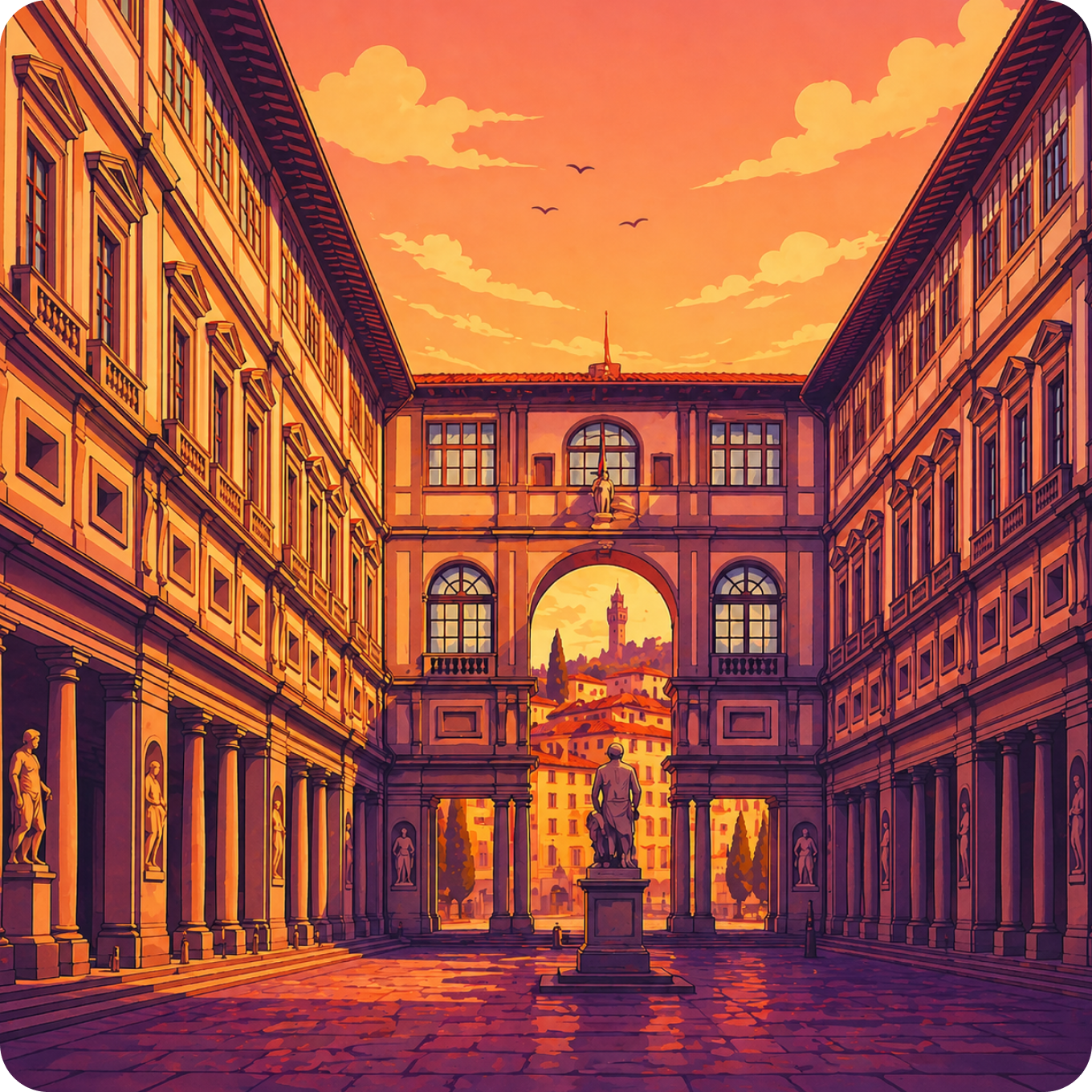
The Uffizi Gallery is not just a museum. It is one of the most important collections of paintings in the world, and one of the clearest windows into how Western art evolved over time.
Its name comes from the Italian word uffici, meaning “offices.” The building was originally commissioned in the 16th century by the powerful Medici family, not as a museum, but as an administrative center for the city. Over time, their private art collection grew within these walls, eventually becoming what is now the Uffizi.
What makes this place unique is not only the quality of the works, but their continuity.
This is not a random collection. It is a visual timeline.
Across its rooms, you can follow the transformation of painting over several centuries. You begin with medieval art, where images are symbolic, flat, and deeply tied to religion. Figures are not meant to look real. They are meant to communicate spiritual meaning.
Then, gradually, something changes.
Artists begin to observe the world more closely. Space acquires depth. Bodies gain weight. Faces begin to express emotion. This shift marks the beginning of the Renaissance, a period in which art becomes a tool for understanding reality, not just representing belief.
The Uffizi holds some of the most important works from this transition. Artists like Giotto di Bondone introduce a new sense of volume and presence. Leonardo da Vinci brings scientific observation into painting. Sandro Botticelli explores ideal beauty and mythology, reflecting the cultural ambitions of Florence at its peak.
As the collection progresses, the style becomes more complex and expressive. With Michelangelo, the human body becomes powerful, almost sculptural. With Caravaggio, art takes a dramatic turn toward realism, contrast, and psychological intensity.
These are not isolated masterpieces. They are part of a larger shift in how humans understand themselves and their place in the world.
The Uffizi represents the moment when art moves from the divine to the human, from the symbolic to the observed, from the ideal to the real.
This audioguide follows that transformation.
Rather than covering everything, it focuses on a small number of key works that define these turning points. The goal is not to provide exhaustive information, but to give a clear, coherent narrative that allows each piece to be understood in context.
By the end, the aim is simple.
To make the evolution of art visible, and to make each work feel intentional, connected, and meaningful within a broader story.
1 - Levante Corridor & Giotto
-
At the beginning of the journey through the Uffizi Gallery, it is worth stepping back from the paintings for a moment and considering the space itself.
One of the defining features of the upper floor, particularly along the Corridoio di Levante, is the ceiling decoration.
These ceilings are richly painted using a style known as grotesque. The term comes from the rediscovery, in the late 15th century, of the ancient Roman frescoes inside the Domus Aurea, the vast palace built by Emperor Nero. When Renaissance artists first encountered these underground ruins, they were fascinated by the intricate, imaginative motifs: hybrid creatures, delicate ornaments, and flowing decorative patterns.
This style quickly became a trend.
Artists such as Raphael adopted and reinterpreted it, and soon it spread across Italy. The ceilings of the Uffizi reflect this fascination. They are not simply decorative, but part of a broader Renaissance interest in reconnecting with classical antiquity.
Alongside the ceilings runs another important element: a long sequence of portraits, often referred to as a kind of visual archive of the Medici family.
These paintings function almost like an early “gallery of memory.” They tell the story of a dynasty that shaped Florence politically, economically, and culturally. The Uffizi, in this sense, is not only a museum of art, but also a monument to power and identity.
From this context, the focus shifts to the paintings themselves, where the evolution of style begins to unfold.
One of the first key works is the Maestà, or Madonna of Ognissanti, by Giotto di Bondone.
Here, two worlds coexist.
On one hand, there are still strong elements of the medieval tradition. The gold background removes the scene from any real environment. The Madonna remains hierarchically larger than the surrounding figures, emphasizing her spiritual importance rather than physical realism.
On the other hand, something new is clearly emerging.
The throne has depth. The figures occupy space. The drapery suggests the volume of the body beneath it. There is a growing sense that these are not just symbols, but presences.
Giotto does not fully break with the past, but he introduces a new direction. A movement toward observation, toward structure, toward a more human dimension.
This transition becomes even more visible in works like the Adoration of the Magi by Gentile da Fabriano.
This painting represents the height of late Gothic elegance. It is rich, detailed, and visually spectacular. When it was commissioned in the early 15th century by the Florentine patron Palla Strozzi, it was considered extraordinarily expensive, a true display of wealth and status.
Every surface is filled with detail. Fabrics, animals, processions, gestures. The scene unfolds almost like a narrative tapestry.
And yet, despite its refinement, it still belongs to a world where beauty is decorative, intricate, and symbolic, rather than grounded in a fully coherent physical space.
A different kind of change appears in the work often referred to as the Lippina, painted by Filippo Lippi.
Here, the transformation becomes more intimate.
After many representations of the Madonna as a distant, almost regal figure, something softer emerges. The Madonna is no longer only a symbol. She begins to feel like a person. A mother.
The interaction between mother and child is gentle, natural, and emotionally convincing. The child no longer appears as a miniature adult, but as a real child, with movement and spontaneity.
There is also a sense of lived experience behind the image. Filippo Lippi is often associated with Lucrezia Buti, the woman believed to have inspired many of his Madonnas. Whether or not this is fully accurate, the painting carries a feeling of personal connection.
This is a crucial shift.
Art is no longer only about the sacred role of the figures represented. It begins to explore relationships, emotions, and the human dimension of those figures.
Across these early rooms, the change is gradual but unmistakable.
From symbolic representation to spatial awareness. From decorative richness to emotional presence. From distant icons to human connection.
This is the beginning of the transformation that will define the Renaissance.
2 - Botticelli
-
As the journey continues through the Uffizi Gallery, the atmosphere shifts once again.
With Sandro Botticelli, painting moves into a different dimension. Less concerned with strict realism, less focused on physical weight and space, and more oriented toward beauty, symbolism, and meaning.
His works are among the most recognizable in the museum. And for good reason. They capture a moment in Florence where art, philosophy, and culture become deeply intertwined.
Among them, one painting stands out as essential: the Primavera.
It is impossible to overlook it.
The work was commissioned by a member of the Medici family, likely Lorenzo di Pierfrancesco, not Lorenzo the Magnificent. Even its title, Primavera, was not given by Botticelli himself, but attributed later.
At first glance, the composition may seem complex.
But there is a structure.
The scene can be read from right to left.
On the far right, Zephyrus, the god of the wind, reaches toward a nymph. She transforms into Flora, the goddess of spring, who then appears scattering flowers across the scene. At the center stands Venus, calm and composed, with Cupid above her. To the left, the Three Graces move in a delicate rhythm, often interpreted as beauty, passion, and chastity. Finally, Mercury closes the composition, turning away as he disperses the clouds.
There is no single, definitive interpretation of this painting.
It is filled with possible meanings, philosophical references, and symbolic layers. What matters is not to decode it completely, but to understand its intention.
This is not a simple narrative.
It is an intellectual image. A reflection of a cultural moment in which mythology, philosophy, and aesthetics are deeply connected.
Even Venus herself is unusual.
Unlike the more familiar image of Venus as a nude figure, here she is clothed. This has often been interpreted as a representation of a more spiritual form of love, rather than purely physical beauty.
But none of these readings are certain.
And that uncertainty is part of the work itself.
Botticelli invites interpretation rather than providing answers.
This same exploration reaches its most iconic form in the Birth of Venus.
Despite the title, the scene does not represent her birth, but rather her arrival on the island of Cyprus.
Here, Venus appears in her most recognizable form: nude, idealized, suspended between reality and imagination.
For centuries, this image has come to represent the ideal of beauty.
Her proportions are not natural. Her posture is carefully constructed. The space around her is simplified, almost abstract.
This is not an observation of the world.
It is a vision of it.
The figure of Venus can also be understood as a symbol of love as a generative force. Not only romantic or physical love, but something broader. A principle that gives life, that creates, that animates.
As with the Primavera, interpretation remains open.
What defines Botticelli is precisely this.
He does not aim to fully explain, nor to fully imitate reality.
Instead, he creates images that exist between clarity and mystery.
Images that are meant not only to be seen, but to be thought about.
3 - Tribuna
-
The Tribuna — A Room as a Universe
Among the many highlights of the Uffizi Gallery, there is one space that stands apart.
It is not a single painting.
It is a room.
The Tribuna is one of the most famous spaces in the history of museums. It was designed in the late 16th century by Bernardo Buontalenti for Francesco I de' Medici, as a private space to display the most precious objects of the Medici collection.
From the beginning, this was not conceived as a simple gallery.
It was intended as a place of wonder. A concentrated expression of beauty, rarity, and knowledge.
The room itself is highly symbolic.
Its shape is octagonal. The number eight has long been associated with ideas of balance, regeneration, and, in some interpretations, the infinite. This geometry already suggests that the space is meant to be more than functional. It is conceptual.
Inside, every element contributes to a larger meaning.
The Tribuna can be read as a microcosm. A representation of the universe through its fundamental elements.
Water is evoked in the ceiling, covered with thousands of shells that create a shimmering, almost organic surface. Air is suggested by the lantern at the top, which opens the space upward. Fire is present in the deep red of the walls, intense and enveloping. Earth is represented by the floor, composed of richly colored marbles.
Everything is designed to create an immersive environment.
At the center of this space stands one of the most important works of the Medici collection: the Venus de’ Medici.
This sculpture, an ancient marble inspired by Greek models, represents an ideal of beauty that predates the Renaissance by many centuries. It is one of the rare works in the Uffizi that directly connects to classical antiquity, not through reinterpretation, but through origin.
Its presence here is deliberate.
Surrounded by paintings, objects, and natural elements, the sculpture becomes the focal point of the room. A point of convergence between art, nature, and philosophy.
The Tribuna, in this sense, is not simply a place to display artworks.
It is an early example of what a museum could be.
Not just a collection, but an experience. A carefully constructed space where objects are arranged to reflect a vision of the world.
In this room, the ambition of the Medici becomes clear.
To collect, to organize, and ultimately to represent the universe itself through art.
4 - Leonardo
-
Leonardo da Vinci — Painting as Investigation
Within the Uffizi Gallery, the works of Leonardo da Vinci mark a decisive turning point.
With Leonardo, painting changes its nature.
It is no longer only a craft, nor simply a means of representation. It becomes a form of investigation. A way to understand the world.
Leonardo approaches art as a scientist.
He studies anatomy, light, movement, and perspective with extraordinary precision. For him, to paint means to observe deeply. To uncover the rules that govern nature, and then translate them into images.
This mindset is already visible in one of his most fascinating works in the Uffizi: the Adoration of the Magi.
This painting was commissioned by the monks of San Donato a Scopeto, who expected Leonardo to complete it within a few years.
He never did.
The work remains unfinished. And yet, it is precisely in this incomplete state that Leonardo’s process becomes visible.
At first glance, the subject is traditional: the moment in which the Magi bring their gifts to the Christ child.
But Leonardo radically transforms the composition.
Instead of a decorative procession, like the one seen in earlier works such as the Adoration of the Magi, here the figures are arranged in a semicircle around the central group of the Virgin and Child.
The focus shifts.
From spectacle to structure. From narrative detail to psychological intensity.
The scene feels dynamic, almost unstable. Figures overlap, gestures interact, expressions vary. It is less a fixed image, and more a moment in motion.
This is Leonardo thinking through painting.
Not finishing it, but exploring it.
The same approach, more resolved, appears in the Annunciation.
Here, Leonardo again departs from tradition.
Instead of placing the scene inside a domestic interior, he sets it outdoors, in a garden. This choice opens the space and allows him to explore one of his central interests: how light and air shape what we see.
Look at the background.
The landscape gradually fades as it recedes into the distance. Colors become cooler, softer, less defined. This is known as atmospheric perspective, a technique that creates depth not through strict geometry, but through the effect of air and light.
Light itself is no longer symbolic.
It interacts with surfaces. It defines form. It creates continuity between objects.
This continuity is reinforced by what is often called sfumato.
Edges are not sharply outlined. They dissolve into shadow and light, creating a softer, more natural transition between forms.
Even the smallest details are grounded in observation.
The wings of the angel, for example, are based on the study of real birds. Leonardo believed that painting should be rooted in knowledge.
There is also a detail often misunderstood.
The arm of the Virgin may appear slightly elongated or disproportionate. But this is not an error. It is an optical effect. The composition is designed to be viewed from a specific angle, slightly from the right, which restores the correct proportions.
Nothing is accidental.
Every element reflects a deeper inquiry into how vision works.
This is what defines Leonardo.
He does not simply paint what he sees.
He paints how seeing itself functions.
And in doing so, he transforms painting into something entirely new.
A discipline that brings together art and science. Observation and imagination. Precision and subtlety.
With Leonardo, the Renaissance reaches one of its most profound moments: the attempt not just to represent reality, but to understand it.
5 - Raphael & Michelangelo
-
Raphael and Michelangelo — Harmony and Power
In this phase of the journey through the Uffizi Gallery, two different visions of the Renaissance come into focus.
On one side, balance, clarity, and harmony.
On the other, tension, force, and structure.These two approaches are embodied by Raphael and Michelangelo.
The Tondo Doni by Michelangelo is a unique work.
It is his only completed painting on a wooden panel, and this already tells something important. Michelangelo always considered himself primarily a sculptor. Even here, in painting, that preference is unmistakable.
Look at the central group.
The Holy Family does not feel simply painted. It feels constructed. Almost carved.
The bodies are powerful, solid, three-dimensional. There is a strong sense of volume and weight. The figures twist and connect in a complex, almost sculptural composition. This torsion, this interlocking of forms, creates a sense of movement contained within the circular space.
The format itself is significant.
The round shape, the tondo, was often associated with domestic settings and, in particular, with births. It was common to commission circular paintings to celebrate the arrival of a child.
For this reason, it is widely believed that the Doni family commissioned this work to mark the birth of their first daughter.
Everything in the painting reflects this tension between intimacy and monumentality.
A family scene, but rendered with the force of sculpture.
Next to the Tondo Doni are the portraits of the couple who commissioned it: Agnolo Doni and Maddalena Strozzi, painted by Raphael.
These portraits immediately recall another famous image: the Mona Lisa by Leonardo da Vinci.
The influence is visible in the composition. The figures are placed in front of a landscape. The pose is stable, composed, and frontal.
But Raphael moves in a different direction.
Where Leonardo creates mystery and ambiguity, Raphael seeks clarity.
The colors are more defined. The forms are more precise. The landscape is present, but less atmospheric, more structured.
What emerges is a strong sense of identity.
These are not symbolic figures. They are individuals, presented with dignity, control, and balance.
Raphael absorbs Leonardo’s innovation, but transforms it into something more accessible, more direct.
In the same room, another work by Raphael completes this dialogue: the Madonna del Cardellino.
Here, Raphael brings together influences from both Leonardo and Michelangelo, but resolves them in his own way.
There is a subtle sculptural quality in the figures, a sense of volume that recalls Michelangelo. At the same time, the composition is carefully balanced, and the interaction between the figures is gentle and natural.
The Madonna, the Child, and Saint John form a stable triangular structure.
This geometry creates harmony.
Unlike Leonardo’s more enigmatic figures, Raphael’s Madonnas are clear, serene, and emotionally open. There is no tension, no ambiguity. The image communicates calm, tenderness, and balance.
Even the symbolic element, the goldfinch, is integrated naturally into the scene. It hints at future suffering, but does not disrupt the overall sense of peace.
The history of this painting adds another layer.
At one point, it was severely damaged when the building that housed it collapsed. The panel broke into multiple fragments. Remarkably, these pieces were recovered and carefully restored, allowing the work to survive.
Placed together, these works reveal a central tension within the Renaissance.
Raphael offers a vision of perfection through balance and clarity.
Michelangelo offers a vision of greatness through power and form.Both are searching for the ideal.
But they reach it in very different ways.
And it is precisely this contrast that defines the richness of this moment in art history
6 - Sala della Niobe
-
Sala della Niobe — Myth, Emotion, and Consequence
Among the many rooms of the Uffizi Gallery, the Sala della Niobe stands out as one of the most evocative.
It is not defined by a single masterpiece, but by a group of sculptures that together create a complete narrative.
This room is dedicated to the myth of Niobe.
According to the story, Niobe was a queen, proud of her many children. She had fourteen in total, seven sons and seven daughters. Her pride led her to boast of her superiority over the goddess Leto, who had only two children: Apollo and Artemis.
This act of arrogance, of placing herself above a divine figure, was seen as a grave offense.
And it demanded punishment.
In response, Leto sent her children to restore that balance. Apollo and Artemis struck down Niobe’s sons and daughters with a rain of arrows.
The sculptures in this room capture that precise moment.
Each figure reacts differently. Some attempt to flee. Others turn in fear. Some collapse under the inevitability of what is happening. There is no single focal point. Instead, the scene unfolds across the space, almost like a frozen sequence of events.
What makes this room particularly powerful is the contrast it creates.
The subject is violent, emotional, and tragic.
But the bodies remain composed, balanced, and idealized. Even in fear and movement, they retain the harmony of classical form.
This tension between content and form is central to classical sculpture.
Suffering is present, but it is controlled. Chaos is depicted, but never fully chaotic.
These works are Roman copies of earlier Greek sculptures, highly valued by collectors such as the Medici family. For them, these statues represented not only artistic excellence, but also a direct connection to the cultural authority of antiquity.
The arrangement of the room reinforces the narrative.
Rather than observing a single object, the viewer is surrounded by the story. The space becomes almost theatrical, placing the observer within the unfolding drama.
At its core, the myth of Niobe is about excess and consequence.
Pride taken too far. The human attempt to rival the divine. And the inevitable restoration of balance.
Through these sculptures, that story becomes immediate.
Not just something to understand, but something to feel.
7 - Tiziano
-
Titian — The Venus of Urbino
Within the collection of the Uffizi Gallery, the Venus of Urbino by Titian marks a profound transformation in the way the female figure is represented.
To understand this painting, it is useful to think back to earlier images of Venus, such as those by Sandro Botticelli.
There, Venus appears distant, idealized, almost suspended outside of reality. She belongs to a mythological world, defined by perfection and symbolism.
Here, everything changes.
This Venus is no longer distant.
She is present, direct, and aware.
She lies within an interior space, not in a mythological landscape. The setting is domestic, structured, and familiar. And most importantly, she looks directly at the viewer.
This gaze is not neutral.
It is confident, almost inviting. Seductive, but controlled. It establishes an immediate relationship between the figure and the observer.
This is no longer an abstract ideal of beauty.
It is a presence.
The body itself is rendered through color and light. Unlike the more sculptural approach of Florentine artists, Titian builds form through soft transitions, creating a sense of warmth and naturalness.
The background reinforces the meaning.
Two figures are engaged in a domestic activity, preparing garments. A small dog rests at the foot of the bed, often interpreted as a symbol of fidelity.
These details suggest that the painting is not purely mythological.
It is commonly believed that it was commissioned by the Duke of Urbino, possibly as a kind of visual model for his young future wife. In this context, the painting takes on an educational dimension, linked to marriage, intimacy, and the role of the woman within a domestic setting.
Venus becomes something more complex.
She is still a goddess, but also a woman. An ideal, but also a figure connected to real life. Beauty here is no longer distant and untouchable. It becomes intimate, immediate, and relational.
This evolution is crucial.
From Botticelli’s Venus, ethereal and symbolic, to this figure, grounded and engaging, the meaning of beauty itself shifts.
With Titian, the Renaissance moves toward a more direct exploration of human experience.
The figure does not simply exist to be observed.
She looks back.
8 - Caravaggio
-
Caravaggio — Medusa and the Power of the Image
At the end of this journey through the Uffizi Gallery, one final work brings everything into sharp focus.
The Medusa by Caravaggio.
This is not a traditional painting.
It is executed on a convex shield, a highly unusual surface that immediately creates a sense of tension. The image does not simply sit in front of you. It projects outward, as if entering your space.
The subject itself is deeply tied to Medici culture.
The painting was gifted to Ferdinando I de' Medici, and the figure of Medusa held a particular significance for the family.
In mythology, Medusa was a creature capable of turning anyone who looked into her eyes to stone.
She was ultimately defeated by Perseus, who avoided her gaze by using a reflective shield, allowing him to cut off her head without being petrified.
Caravaggio captures the exact moment of that transformation.
Not a static symbol, but an instant.
The head is severed, the expression frozen between shock and pain. The mouth is open, the eyes wide, the snakes in motion. Everything feels immediate, almost violent.
This is where Caravaggio breaks completely from earlier traditions.
There is no idealization.
No distance.
Only raw, direct reality.
The technical challenge of painting on a convex surface only amplifies this effect. The curvature distorts the image slightly, enhancing the sense that the figure is alive, emerging toward the viewer.
And there is an irony at the heart of this work.
Medusa’s power was to petrify those who looked at her.
Here, the viewer is invited to look directly at her face.
The danger becomes the experience.
You have now reached the end of this journey.
From the early attempts to give form to the sacred…
To the balance and harmony of the Renaissance…
To the intensity and realism of Caravaggio…What you have seen is more than a sequence of artworks.
It is a transformation in how humans understand the world, and themselves.
Art moves from symbol to observation. From distance to presence. From the ideal to the real.
And through this process, it becomes something deeply human.
My name is Alessandro.
And I hope you enjoyed this experience as much as I enjoyed guiding you through it.
Take your time before leaving.
Look again at what caught your attention. Notice what feels different now.
Because the goal was never just to show you the museum.
It was to help you see it.