
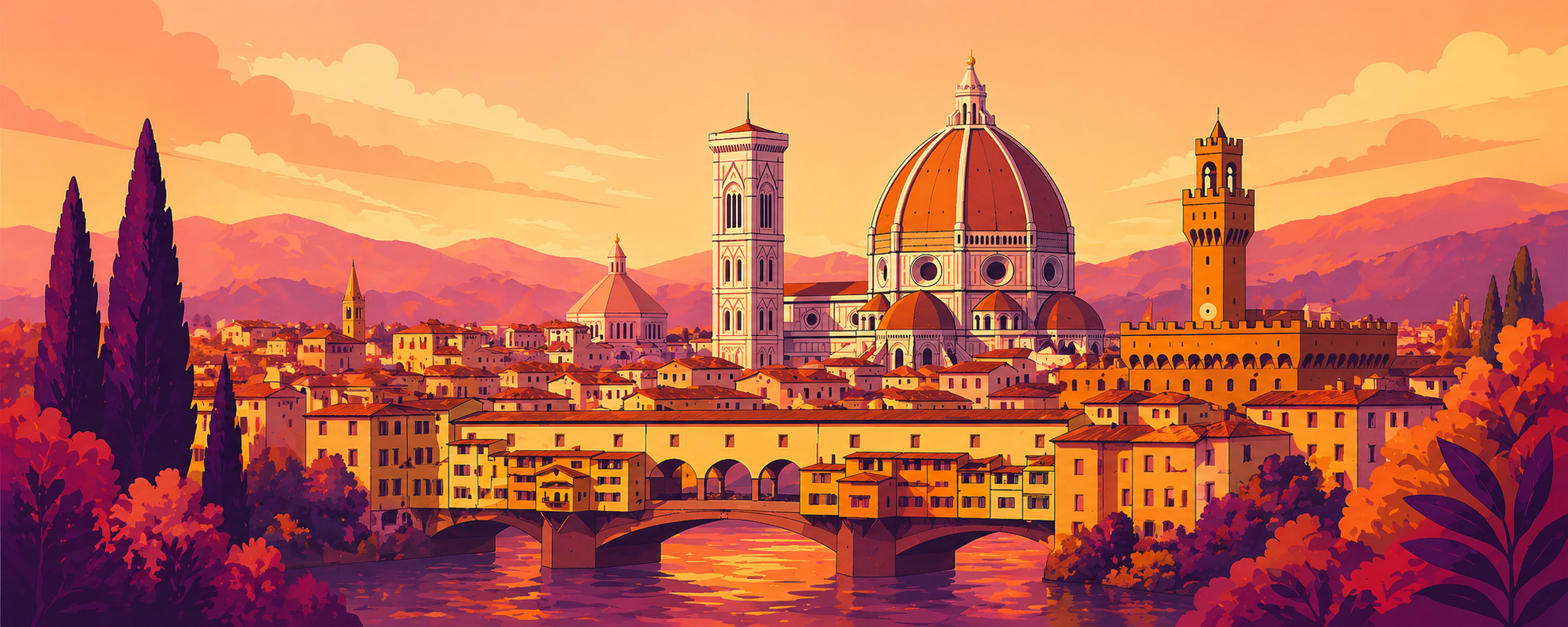
Florence
Walking Tour
Audio by: Alessandro
Intro
-
Ciao! Hello, and welcome to Florence. My name is Alessandro, I'm Italian, and Florence is my favorite city in all of Italy. I'm so happy you're here.
I want you to take a breath for a second. Wherever you're standing right now, feel it. This city is the heart of Italy, the place where the beauty we Italians are so proud of was, in a way, invented. People come here from every corner of the world to feel something they can't quite name. The Italians have a phrase for it, la dolce vita, the sweet life. And Florence is where that sweetness was born. So: you're in the right place, and I promise you, you're going to fall a little bit in love today.
Now, here's how this works, you and me. I can't be there in person to walk beside you, but honestly, I think this is even better. Because it means you go at your speed. We're going to walk through Florence together, stopping at ten places, and at each one, I'll be right here in your ear to tell you the stories, the real ones, the secret ones, the ones the guidebooks don't bother with. Between the stops, I'll go quiet, and you just stroll, take your photos, get a little lost, get a gelato. No rush. When you reach the next place, press play, and I'll be waiting.
And I'm not going to give you a dry list of dates and names. I want to tell you the why, why this city looks the way it does, why a place run by wool merchants and bankers ended up the most beautiful city on earth. Florence has a secret hiding in plain sight, and by the end of our walk, when we climb up high and look back over the whole city together, you're going to see it. I can't wait to show you.
One small thing: wear comfortable shoes, drink some water, and don't try to rush Florence. She doesn't like that. Let her take her time with you.
So, let's begin. Our first stop is a church that is really a hall of fame, full of the most famous Italians who ever lived, and one very beautiful tomb that has been completely empty for seven hundred years. Make your way there whenever you're ready. I'll meet you in front of the Basilica di Santa Croce. Andiamo, let's go
Stop A - Basilica di Santa Croce
-
Welcome to Florence, we are starting our tour in front of the Basilica di Santa Croce. You're standing in front of a church, but I want you to think of it as something else entirely. Think of it as a hall of fame.
Behind these walls lie Michelangelo. Galileo. Machiavelli. The composer Rossini. This is where Florence buries the people it's proudest of, and here's the thing worth holding onto for the next couple of hours: notice who they are. Not kings. Not emperors. An artist. A scientist. A political writer. A musician. Other cities built their grandest tombs for the men who ruled them. Florence built hers for the men who made something.
That's not an accident, and it's not a small thing. Florence never had a king. No royal court, no crown. It was run by wool merchants and bankers and members of trade guilds, self‑made men, competing with each other. And when you have no king to glorify, you find other ways to compete. You compete through what you build. Through what you create. Keep that idea in your pocket today, because you're going to watch it play out on every corner of this city. Florence is what happens when ambition has no throne to climb, so it climbs into art instead.
Now, step a little closer, because this hall of fame has a secret. Somewhere along the right‑hand wall inside is the tomb of Dante, the father of the Italian language, the man who wrote the Divine Comedy. A magnificent tomb. And it is completely empty.
Here's why. Florence exiled Dante. In the year 1302, in the middle of the city's vicious politics, he was thrown out under threat of being burned alive if he ever returned. He spent the rest of his life wandering, and he died far away, in the city of Ravenna, in 1321, and that's where they buried him. Centuries later, Florence came to its senses, realized it had banished its greatest poet, and asked for the body back. Ravenna said no. And Ravenna has gone on saying no for seven hundred years. They have his bones, and they will not return them.
So Florence built this beautiful tomb anyway, and left it hollow. A monument to its own regret. And every year, to this day, the city of Florence sends oil to Ravenna, to keep the lamp burning at the grave of the poet it threw away. Quiet penance, paid by the barrel, for seven centuries.
One more, while you're looking, and this one's stranger. Galileo is buried here too, in a grand marble tomb. But for almost a hundred years after he died, the Church wouldn't allow it. He'd been condemned for daring to say the Earth moves around the sun, so they tucked his body away in a small side room, no monument, out of sight. It took ninety‑five years before Florence was finally allowed to move him here, to the place of honor he has now. And when they opened the original grave to move him, his admirers helped themselves to souvenirs. They snipped off three of his fingers and one of his teeth. To this day, one of those fingers sits in a museum just a few streets from here, preserved upright in a glass egg, pointing, forever, at the sky he was punished for studying.
Take a few minutes. Walk the right‑hand wall, find the empty tomb and the man who pointed at the heavens. Then, when you're ready, head north, up toward the city center, we're going somewhere much quieter next, a place where modern Florence comes to read and study, with a secret view I think you'll love. I'll meet you at the Biblioteca delle Oblate.
Stop B - Biblioteca delle Oblate
-
You've left the monuments behind for a moment. Good. Because I want to show you a different Florence, not the one in the guidebooks, but the one people actually live in.
You're at the Biblioteca delle Oblate, the city's public library. Walk in. There are students hunched over laptops, parents with kids in the children's section, locals reading the paper. It's ordinary, and that's exactly the point. But head up to the second floor, to the café terrace, and look out the window.
There it is. The dome.
Brunelleschi's dome, filling the frame, close enough that you can read the texture of the tiles. This is one of the best free views in Florence, and almost no tourist knows it's here, they're all crammed into the piazza below, paying for the privilege of standing in a crowd. You're up here with the students, looking at the back of the greatest dome ever raised, with a coffee. Hold this image, because in a few minutes you're going to walk right up to its base, and I want you to remember what it looked like from a distance first, whole, floating, almost impossible.
Now here's the thread that ties this quiet building back to the poet you just met. This was once a convent, home to a community of nursing sisters, the Oblate, who cared for the sick. And the hospital they served, Santa Maria Nuova, just around the corner and still running today, was founded back in 1288 by a man named Folco Portinari. That name might mean nothing to you. But Folco Portinari had a daughter. Her name was Beatrice, and Beatrice was the woman Dante loved his entire life, the woman he made into his guide through Paradise in the Divine Comedy. The poet whose empty tomb you just stood in front of spent eternity writing toward a girl whose father built the hospital these sisters ran. Florence is small, and everything in it is connected. You'll feel that more and more as we go.
Take a few minutes. Get the coffee if you like, soak in the view. Then come back down and head for the piazza, follow the streets toward that dome you just saw through the window. We're about to stand under a building that began with an act of almost reckless faith: they started a cathedral with a hole in the roof too big for anyone alive to close. I'll meet you in Piazza del Duomo.
Stop C - Piazza del Duomo
-
And there it is. Up close now, no window frame, no distance. Just the sheer size of it, the green and white and pink marble climbing up further than feels reasonable, and that dome you saw from across the city now hanging directly over your head. Take a second. Everyone does.
You already half‑know the famous story, so I won't labor it: when Florence began this cathedral, around 1296, they designed it with a hole at the top too wide for any technology on earth to cover. No one knew how to build a dome that big. It hadn't been done since ancient Rome, and the secret had been lost for a thousand years. They built it anyway, and then left the hole open for decades, trusting that some future Florentine would figure it out before the rain ruined everything. That is an astonishing act of civic faith: betting your cathedral on a person who hasn't been born yet. And it paid off, when a goldsmith named Filippo Brunelleschi cracked it and raised the dome you're standing under.
But I want to point you somewhere most people walk straight past, turn and look at the smaller building out front, the one that stands alone. That's the Baptistery. And that building, not the cathedral, is where this whole city's golden age really begins.
In the year 1401, the guild that ran this square held a competition. The prize: the commission to design a new set of bronze doors for the Baptistery. The whole city's artistic ambition poured into it, and it came down to two young men, Lorenzo Ghiberti and the very same Filippo Brunelleschi. They each cast a trial panel. Ghiberti won. And here's the part that matters: Brunelleschi lost so badly, was so stung, that he left Florence, went to Rome, and spent years obsessively studying the ancient ruins and how the Romans built. He came back with exactly the knowledge needed to raise the impossible dome. In other words, he lost a sculpture contest, and the consolation prize was the greatest dome in the world.
Hold onto that, because it's the engine of everything you'll see today. This was a city with no king and no crown, run by merchants and guilds who competed not with armies, but with beauty. A contest for a pair of doors lit the fuse on the entire Renaissance. And you're going to watch that same competitive fire, guild against guild, at the very next stop.
One last thing, and it's a quiet one. Brunelleschi is buried inside this cathedral, down in the crypt beneath your feet. That is almost unheard of. Churches like this are resting places for saints and bishops, not builders. But Florence made an exception for the man who closed the hole in the sky. The architect sleeps inside his own masterpiece.
Walk the exterior if you like, find the Baptistery doors, take in the scale. Then head south, just a couple of minutes down toward the river, and look for a tall, narrow building that looks like a church wearing the wrong clothes. It started life as a grain market. It became the strangest and most competitive art gallery in Florence, and almost nobody stops there. I'll meet you at Orsanmichele.
Stop D - Orsanmichele
-
Look up at this building. It's tall, square, severe, more like a fortress than a church, with great arched windows that look like they were filled in later. They were. Because this was never meant to be a church at all. This was a grain market.
Back in the 1300s, this was the spot where Florence stored and sold its grain, the food supply of the whole city, right here. The ground floor was an open loggia full of merchants and sacks of wheat; the upper floors were granaries. And if you step inside, you can still find the proof: the old chutes are still there, built into the pillars, that once let grain pour down from the storerooms above into the market below. A church with grain chutes in its columns. Hold that image, it tells you everything about this city. In Florence, the sacred and the commercial were never far apart. The same hands that prayed also weighed the wheat.
But here's why I brought you to a building almost no tourist stops at. Look around the outside, at the walls, set into them, all the way around, are niches, and in each niche stands a statue of a saint. They look decorative. They are anything but. They are the scoreboard of a competition that defines this entire city.
Remember the idea I asked you to keep in your pocket, a city with no king, where merchants and guilds competed through beauty instead of battle? This is where you can see it. Each of these niches was assigned to one of Florence's great trade guilds, the wool merchants, the bankers, the armorers, the stonemasons. And each guild was expected to fill its niche with a statue of its patron saint. Now imagine you're the bankers' guild, and the wool guild next door has just hired the most famous sculptor in the city and unveiled something breathtaking. What do you do? You cannot be outdone. So you hire someone better. You spend more.
And that competition, guild trying to out‑sculpt guild, on a public wall, for the whole city to judge, pulled in the greatest artists of the age. Donatello. Ghiberti, the same man who won those Baptistery doors. Verrocchio, who would go on to teach a boy named Leonardo da Vinci. The masterpieces stacked up here, niche beside niche, not because a king commanded it, but because no guild could bear to look poorer than its rivals. Vanity and faith and rivalry, cast in bronze and marble. The spine of this whole city, made visible on one building.
And one last gift, because it's the kind of thing this tour is for: the statues you see on the walls now are copies. The originals, the real Donatello, the real Ghiberti, were taken inside and up, to a museum on the upper floors of this very building. It's free. It's almost always empty. You can stand alone in a quiet room with sculptures that changed the course of art, and often there's no one else there at all.
Take a slow walk around all four sides, find the niches, notice how no two are alike, each guild shouting a little louder than the last. Then, when you're ready, head south just a minute or two, toward the great open square ahead. You're about to step into the living room of the Florentine republic, an open‑air stage where the city crowned its heroes and burned its enemies. I'll meet you in Piazza della Signoria.
Stop E - Piazza della Signoria
-
You've just walked out of a narrow street into open space, and suddenly there's a fortress with a tower stabbing into the sky, a fountain full of sea‑gods, and statues everywhere you look. This is Piazza della Signoria, and for seven hundred years this has been the political heart of Florence. Not the religious heart, that was the Duomo. This is where the city governed itself, argued with itself, and on its darkest days, turned on itself.
That great fortress‑palace with the tower is the Palazzo Vecchio, the town hall, then and now. This square was the open‑air stage of the Florentine republic. When the city had something to celebrate, it happened here. When it needed to make a statement, it carved that statement in marble and stood it in this square for everyone to see. Look at the statues around you: this is less a museum than a centuries‑long political argument conducted in stone.
And the most famous figure of all once stood right beside the palace door. Look for the muscular nude, that's David. Now, this is a copy, and I'll be honest with you about that, because the original is waiting for you elsewhere in this city, in a room I hope you'll visit, where he stands under his own dome of light. But notice where they put him, and why. David, the underdog who strikes down a giant, was the perfect symbol for Florence: a small republic surrounded by larger, more powerful enemies, refusing to kneel. They didn't put him here as decoration. They put him here as a warning, facing outward, toward Rome. A statue as a piece of foreign policy.
Now I want to take you to a single paving stone, because this beautiful square has a darker memory. Somewhere out in the open expanse, set into the ground, there's a small round marble plaque. Most people walk straight over it. It marks the exact spot where, in 1498, a man was burned alive.
His name was Savonarola, a fiery preacher who, for a few years, seized control of this pleasure‑loving city and tried to purge it. He convinced Florentines to throw their mirrors, their fine clothes, their paintings, their books, anything beautiful or vain, onto enormous fires right here in this square. History calls them the Bonfires of the Vanities. For a moment, the most artistic city on earth was burning its own art in this piazza. But Florence turned. The mood broke, the preacher fell from power, and on this very spot where he'd burned the city's treasures, the city burned him. The plaque marks the place. A quiet reminder, underfoot, of how fast a crowd can change its mind.
One last thing, and treat this one as a charming legend rather than gospel. On the wall of the Palazzo Vecchio, to the right of the entrance, there's a rough profile of a man's face carved into the stone, the Florentines call it l'Importuno, "the annoying one." The story goes that Michelangelo himself carved it, supposedly while standing with his hands behind his back, half‑listening to a tiresome man who wouldn't stop talking. Is it true? Probably not. But you're standing in a city where even the idle graffiti gets attributed to Michelangelo, and honestly, that tells you something true about the place, even if the story isn't.
Take your time here. Find David facing his enemies, find the plaque underfoot, hunt for the face on the wall. Then look for the long, narrow courtyard opening toward the river, framed by statues, that's where we go next. It was built as government offices, and the name says exactly that. But those "offices" became the first great art museum in the world. I'll meet you at the entrance to the Uffizi.
Stop F - Galleria degli Uffizi
-
Look down this long, narrow courtyard, two great wings of identical arches running all the way to the river, with statues lining the lower level. It's elegant, symmetrical, official‑looking. And that's exactly what it was built to be. Because the word Uffizi simply means "offices."
This was bureaucracy. Around 1560, Cosimo I de' Medici, the man who'd turned Florence from a republic into his own private duchy, wanted all the city's administrative offices, the magistrates and guilds and record‑keepers, gathered into one grand headquarters. So he commissioned this building from his court artist, Giorgio Vasari. The first great art museum in the world began its life as a government office block. Hold that thought, because it's pure Florence: even the bureaucracy was built beautifully.
But the Medici were collectors, obsessive ones. Generation after generation, they gathered paintings, sculptures, treasures, and they began filling the top floor of these offices with their private collection. Over time the art crowded out the clerks, and the offices quietly became a gallery. Today the rooms above you hold Botticelli's Birth of Venus, works by Leonardo, Michelangelo, Raphael, Caravaggio, one of the greatest concentrations of art anywhere on earth, sitting on top of what was meant to be a filing cabinet for a duchy.
Now, the same man who built this, Vasari, built something else here, something hidden, and I want you to know about it before our next stop, because it explains a mystery you're about to walk into. Look up toward the top of the building, on the river side. Running along it is an enclosed passage, a corridor with little round windows. That's the Vasari Corridor. Cosimo had it built in 1565, and here's the astonishing part: it was finished in about five months. Nearly a kilometer of private, elevated walkway, thrown up in a single winter.
Why the rush? The Medici were rulers now, not merchants, and rulers have enemies. Cosimo wanted to move between his palace on this side of the river and the great Pitti Palace on the far side without ever setting foot in the public street, without being seen, without being vulnerable. So Vasari built him a secret passage in the sky that runs out of this building, over the top of the next bridge you're going to visit, and across to the other side. A corridor of power, floating above the heads of ordinary Florentines. Remember it, because in about five minutes it's going to explain why an entire bridge smells of gold.
And one last story, the most important one, because without it, none of this would be here. The Medici family ruled Florence, on and off, for nearly three hundred years. And then, in the 1740s, they died out. The very last of the line was a woman named Anna Maria Luisa de' Medici. She had no children, no heir. The dynasty ended with her. And she could have done what dynasties usually do, let the treasures be sold off, scattered, carried away to Vienna or Paris by whoever inherited the rubble.
She did the opposite. She signed what's called the Family Pact, and she willed the entire Medici collection, all of it, every painting and statue and gem, to the city of Florence. On one condition: that none of it could ever leave the city. It had to remain here, forever, for everyone. And that is the only reason all of this is still in Florence today, instead of hanging in the museums of other countries. The last of the rulers gave it all back to the citizens. Even the kings, in the end, handed Florence to its people.
Take a moment with the courtyard, the statues, the corridor running overhead. Then head for the river, it's just steps away now, and walk onto the bridge crowded with jewelers' shops. It should, by rights, be a bridge of butchers and the stink of meat. Instead it glitters with gold. I just told you the reason why, see if you can spot it overhead. I'll meet you on the Ponte Vecchio.
Stop G - Ponte Vecchio
-
Here you are, on the most famous bridge in Florence, maybe in the world. The Ponte Vecchio, the "old bridge." And it really is old: there's been a bridge on this exact spot since Roman times, and this version has stood since 1345. Take in the strange sight of it, shops built right onto the bridge itself, hanging out over the water on wooden brackets, as if a little street of houses decided to wade across the river and stopped halfway.
And look at what those shops sell. Gold. Jewelry. Every one of them, goldsmiths and jewelers, glittering windows the whole way across. It has been this way for centuries. But it was not always so, and the reason it changed is the secret I've been promising you since the Uffizi. So look up. Above the shops, on this side, you can still see it, that enclosed passage with the little round windows. The Vasari Corridor. It runs right over your head, and then along the top of these very shops, across the bridge, to the other side.
Now here's the story. For most of its life, this was not a bridge of gold. It was a bridge of meat. The shops you're standing among were butchers, this was the meat market, and it was chosen precisely because hanging out over the river gave the butchers an easy way to dispose of their waste: blood, guts, offal, straight down into the Arno. You can imagine the smell. You can imagine the flies.
And then, in 1565, Cosimo de' Medici built his private corridor directly over the top of it, his elegant, secret walkway between palaces. And every time the duke wished to cross, he had to pass above a reeking row of butcher shops, with the stench of raw meat rising up to meet him. A grand duke does not tolerate that for long. So in 1593, his successor Ferdinando issued a decree: the butchers were evicted, every one of them, and in their place came the goldsmiths and jewelers. Cleaner. Quieter. And far more fitting for a bridge with a royal corridor on its roof. That single decree, four hundred years ago, is why you're standing in a tunnel of gold today instead of holding your nose. The luxury you see exists because a duke didn't want to smell his subjects' butchery.
One more, and it's the reason this bridge still exists at all. In 1944, as the Germans retreated from Florence in the Second World War, they were ordered to blow up every bridge across the Arno to slow the Allied advance. And they did, every single one. Except this one. The Ponte Vecchio was spared. The exact reason is still debated, some say Hitler himself, who had visited Florence and walked through that very corridor, gave the order to save it. Whatever the truth, the bridges to the left and right of you were destroyed and later rebuilt. This one is original. When you stand here, you stand on the one bridge the war let live.
Walk across slowly, look in the gold‑lit windows, find the corridor running overhead, and at the middle of the bridge there's an opening where you can stop and look out along the river. Then keep going, all the way over to the far side. You're crossing into the Oltrarno now, literally "beyond the Arno", the other Florence. Rougher, realer, full of workshops and artisans, where the city actually makes things. We're headed to a plain‑faced church there that hides a masterpiece carved by a teenager. I'll meet you in Piazza Santo Spirito.
Stop H - Piazza Santo Spirito
-
You've crossed the river, and you can feel the change. The crowds thin. The streets get a little scruffier, a little more lived‑in. Washing hangs from windows; there are workshops with their doors open, artisans actually working inside. This is the Oltrarno, and this square, Piazza Santo Spirito, is its heart. Locals drink coffee here in the morning and wine here at night, on the steps of a church that, at first glance, looks like nothing at all.
Look at its face. It's blank. A plain, pale wall with almost no decoration, no marble, no statues, no grand design. Most people glance at it and move on. But that empty façade is hiding one of the most perfect interiors ever built in this city, and it was the final work of a man you've been walking with all day. Filippo Brunelleschi. The man who closed the dome.
Step inside, if it's open, and you'll see it immediately. After the riot of decoration everywhere else in Florence, this interior is calm, almost mathematical. Rows of grey stone columns marching in perfect rhythm, soft light, pure proportion. Brunelleschi designed this near the end of his life, and he didn't live to see it finished. The blank face outside isn't neglect, it's almost a promise: that the beauty here is in the order, the harmony, the bones of the thing, not in the show. It's the quiet masterpiece of a man whose loudest work hangs over the whole city.
But here's the reason I really brought you across the river. Somewhere inside this church hangs a small wooden crucifix, a slender, pale, almost delicate figure of Christ. And it is widely believed to be the work of Michelangelo, carved when he was just seventeen years old.
Now, the story behind it tells you who Michelangelo was about to become. As a teenager, he was obsessed with the human body, not just how it looked, but how it worked, underneath. And the monastery attached to this church ran a hospital. So the prior here, the head of the community, made the young Michelangelo a quiet, slightly scandalous offer: in exchange for his work, he could come at night and secretly study the bodies of the dead from the hospital, dissect them, learn the muscles and bones from the inside. It was the kind of thing that could get you in serious trouble with the Church. But it's where Michelangelo learned the anatomy that would one day let him carve a David so alive you'd swear you could see the blood moving under the marble. And in thanks to the prior who let him do it, the boy is said to have carved this crucifix as a gift.
I'll be honest with you, as I always am: not every scholar agrees the crucifix is his, the attribution is debated. But the dissection story is well documented, and it happened here. The man whose finished David learned his trade by candlelight, in the back rooms of this quiet church, with the dead as his teachers.
Take a moment inside if the doors are open, find the calm of Brunelleschi's columns, find the pale crucifix. Then come back out to the square. We have just two stops left, and they're both about looking back, at the river, and then at the whole of Florence laid out beneath you. Head down toward the water again, eastward along the bank. I'll meet you at the Ponte alle Grazie a bridge with the best view of Ponte Vecchio.
Stop I - Ponte alle Grazie
-
Stop here for a moment, in the middle of the bridge. Catch your breath, you've earned it, and there's a climb ahead. But first, turn and look back upriver.
There it is: the Ponte Vecchio, seen whole, from a distance, the way you couldn't see it when you were standing on top of it. The little shops piled up over the water, the corridor running along its roof, the whole strange, beautiful thing reflected in the Arno. This is the view people picture when they picture Florence. Take it in.
The bridge you're standing on now, the Ponte alle Grazie, is quieter, plainer, and it has a secret of its own. The bridge that stood here for centuries was extraordinary: it didn't just carry a road, it carried tiny buildings on its piers. Little chapels. And even, at one time, the cells of religious hermits, people who chose to live out their days in a small stone room suspended over the rushing river, between the water and the sky. A bridge that was also a row of hermitages. Picture it: pilgrims crossing, and behind those walls, someone who had given up the world entirely, listening to the Arno run beneath the floor.
That old bridge is gone now, like almost every bridge in the city, it was destroyed in 1944, and what you stand on is the modern replacement. But the river is the same river, the view is the same view, and the hermits' Arno still runs underneath you.
Now, the last stretch. From here, you climb. Cross the river and follow the road up; it winds uphill for a while, and there are steps near the top. It's a real climb, so take it at your own pace, there's no rush. Just walk, and let Florence fall away below you as you rise. When you come out at the top, into a wide open terrace with the whole city spread out at your feet, that's where I'll be waiting, for the last thing I have to show you. I'll meet you at Piazzale Michelangelo.
Stop J - Piazzale Michelangelo
-
You made the climb. Now stop. Walk to the edge of the terrace, put your hands on the railing, and look.
There it is. All of it. The whole of Florence, laid out below you in the bowl of its hills, with the river running through the middle and the green hills rising on the far side. And rising above everything, unmistakable, exactly where it's been the whole time, Brunelleschi's dome. The same dome you first saw framed in a library window hours ago, then stood beneath in the piazza, then watched float over the rooftops as you crossed the river. From up here you finally see it for what it is: the thing the entire city is built around. Nothing is taller. Nothing was ever allowed to be.
Take your time finding the rest, because you know them now. That tower beside the dome, the Palazzo Vecchio, the town hall, where David stood guard and Savonarola burned. Trace the river to the bridges, and find the Ponte Vecchio, the little jeweled bridge you walked across. And over to the right, look for the great church with the long body and the pointed façade, Santa Croce. The hall of fame. Where this all began, at the beginning of our tour, with an empty tomb.
Now I want to tell you what you're actually looking at, because it isn't just a pretty skyline. Everything down there was built by a city with no king. No royal palace dominates this view, because there was never a royal court to build one. What you see instead is what merchants and bankers and guildsmen made when they competed not for territory, but for beauty, a dome to outdo every dome, doors worth a contest, statues on a grain market, a cathedral begun on faith that someone unborn would finish it. Every stone you can see from up here was laid by citizens trying to outdo one another, and what they built by competing is one of the most beautiful cities the human race has ever made. That's the secret I asked you to keep in your pocket at the very first stop. Here it is, laid out at your feet. This is what ambition builds when it has no throne to climb.
And here, at the center of this terrace, stands a familiar figure. Look, it's David again. In bronze this time, green‑dark against the sky. You've met him three times now: the marble copy standing guard at the Palazzo Vecchio, and if you've walked with me through the Accademia, you've stood before the original himself, the real David, glowing white under his own dome of light. The boy who learned anatomy from the dead in a quiet Oltrarno church grew up to carve the figure this whole city chose as its own face. And here he stands again, lifted up above all of Florence, watching over the city that made him.
One last secret, for the ones who don't want it to end. Look up the hill behind you, just a little higher, a few minutes' walk up. There's a church up there called San Miniato al Monte. Most people never bother; they get their photo here and leave. But up there is an even older, even more beautiful view, and a building far more ancient and serene than this terrace, and if you time it right, around sunset, the monks still sing. Vespers, in Gregorian chant, the way it's been sung for a thousand years, in a golden church above a golden city. If you have it in you, climb the last little way. It's the quietest, finest ending Florence can give you.
But whether you climb that last hill or stop right here, let me leave you with this. Think back to where we started, to Santa Croce, and the tombs. Michelangelo. Galileo. Machiavelli. Dante's empty grave. This morning they were just names on stone boxes. But look out now at this city, the dome, the towers, the bridges, the statues. Those people, and thousands like them whose names we've lost, built all of this. Not for a king. Not because they were ordered to. But because in this strange, brilliant, quarrelsome little city, the way you mattered, the way you competed, the way you became immortal, was to make something beautiful and leave it behind for everyone who came after.
That's the end of our walk. Thank you for spending it with me. Go find a glass of wine, watch the light change over the dome, and stay until the city turns gold. You've earned it. Welcome to Florence, now you can say you've really seen it.